

Table of Contents
- What Are the Standard Plywood Sheet Sizes?
- Why Is 4×8 Plywood So Common?
- 1220×2440 Plywood: Metric Equivalent of 4×8
- Standard Plywood Sheet Size Chart
- Other Plywood Sheet Dimensions Buyers Should Know
- Plywood Sizes by Product Type
- How Plywood Thickness Changes the Specification
- Nominal vs Actual Plywood Dimensions
- How to Choose the Right Plywood Sheet Size
- How Sheet Size Affects Cutting Waste
- How Plywood Dimensions Affect Container Loading
- Custom Plywood Sizes: When Do You Need Them?
- What Global Buyers Should Put in a Plywood RFQ
- Why Buy Standard Plywood Sizes from a China Factory?
- Why Consider Dongstar for Bulk Plywood?
- Frequently Asked Questions About Plywood Sheet Sizes
- Final Buying Checklist
When buying plywood for a construction project, furniture factory, distribution business, or import program, the first specification many buyers look at is the sheet size.
That sounds straightforward.
Then the quotation arrives.
One supplier offers 4×8 plywood sheet. Another writes 1220×2440 mm. A third quotes 1250×2500 mm. Someone else offers 4×10 ft.
Are they interchangeable?
Not always.
For small projects, the difference may be insignificant. For a buyer ordering thousands of sheets, however, the wrong plywood sheet dimensions can affect cutting plans, warehouse storage, container loading, installation, and total landed cost.
The good news is that most international plywood purchasing follows a relatively small number of common formats.
The 4×8 format, approximately 1220×2440 mm, is one of the most widely recognized plywood dimensions. Dongstar’s existing product information lists 1220×2440 mm, 1250×2500 mm and 1250×3000 mm among available commercial plywood formats, with customized sizes also possible.
But the right size isn’t necessarily the most popular size.
For global B2B buyers, the real question is:
Which plywood sheet dimension gives the best combination of project fit, material utilization, handling efficiency and delivered cost?
Let’s look at the options.
What Are the Standard Plywood Sheet Sizes?
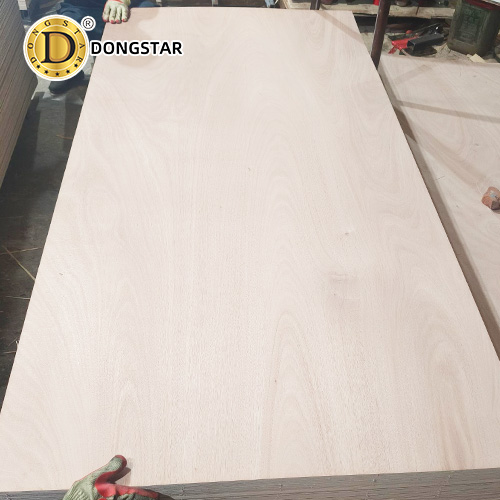
The 4×8 plywood sheet is the most familiar format in many construction and woodworking markets.
Its nominal dimensions are:
| Format | Imperial | Metric Approximation | Typical Applications |
|---|---|---|---|
| 4×8 | 48 × 96 in | 1220 × 2440 mm | Construction, furniture, cabinets |
| 4×4 | 48 × 48 in | 1220 × 1220 mm | Small panels, furniture |
| 5×5 | 60 × 60 in | 1525 × 1525 mm | Furniture, specialty panels |
| 4×10 | 48 × 120 in | Approx. 1220 × 3050 mm | Large surfaces |
| 5×10 | 60 × 120 in | Approx. 1525 × 3050 mm | Large projects |
These are common reference formats, not a universal list of every plywood dimension manufactured worldwide.
Different manufacturers may offer different sizes depending on:
- Production equipment
- Target market
- Plywood type
- Veneer availability
- Customer requirements
- Minimum order quantity
Dongstar’s film faced plywood specifications, for example, include 1220×2440 mm, 1250×2500 mm, 1500×3000 mm and several other formats.
That’s important for project buyers because the best plywood size is often application-specific.
A construction contractor may prefer 4×8.
A furniture manufacturer may prefer a metric sheet that fits its CNC cutting program.
A formwork contractor may need a larger panel to reduce the number of joints.
Why Is 4×8 Plywood So Common?
There is a practical reason 4×8 plywood became such a familiar industry format.
A 4-foot-wide by 8-foot-long sheet provides a useful balance between coverage, handling and manufacturing efficiency.
One nominal 4×8 sheet covers approximately 32 square feet, or about 2.98 square meters.
That makes material estimating relatively simple.
For example, a project requiring approximately 320 square feet of panel area would theoretically need:
320 ÷ 32 = 10 sheets
In practice, the buyer should allow additional material for cutting, openings, damaged panels and layout waste.
The format is also convenient for many construction systems.
It can be used for:
- Wall sheathing
- Roof decking
- Subflooring
- Furniture
- Cabinet construction
- Packaging
- Interior panels
- General woodworking
Dongstar’s existing 4×8 guide also identifies 1220×2440 mm as the metric equivalent and explains why this format is widely used.
For international B2B purchasing, another advantage is familiarity.
When a buyer in one country says “4×8 plywood,” a supplier in another country usually understands the basic requirement immediately.
But that’s where the easy part ends.
A professional purchase order should still specify the actual metric dimensions, thickness and tolerance.
1220×2440 Plywood: Metric Equivalent of 4×8
For many international buyers, 1220×2440 plywood is simply the metric way of describing a nominal 4×8 sheet.
The conversion is commonly expressed as:
4 ft × 8 ft ≈ 1220 mm × 2440 mm
However, buyers should understand that this doesn’t mean every sheet sold as 4×8 will measure exactly 1220 × 2440 mm after manufacturing.
Plywood goes through processes such as:
- Veneer preparation
- Lay-up
- Hot pressing
- Trimming
- Sanding
- Calibration
These processes can affect the final dimensions.
This is why a specification such as:
1220 × 2440 × 18 mm
is better for a factory RFQ than simply:
4×8 plywood
The first tells the manufacturer exactly what you’re requesting.
Dongstar’s commercial plywood product information lists 1220×2440 mm alongside 1250×2500 mm and 1250×3000 mm, and also states that customized dimensions can be discussed.
For buyers working with CNC equipment or automated production lines, this distinction matters even more.
A few millimeters of variation may affect the cutting program or final component dimensions.
Standard Plywood Sheet Size Chart
Here is a practical reference for buyers comparing common plywood sheet dimensions.
| Common Size | Approx. Metric Size | Approx. Area | Typical B2B Applications |
|---|---|---|---|
| 4×4 ft | 1220×1220 mm | 1.49 m² | Furniture, smaller components |
| 4×8 ft | 1220×2440 mm | 2.98 m² | Construction, furniture, cabinets |
| 5×5 ft | 1525×1525 mm | 2.33 m² | Furniture, specialty applications |
| 4×10 ft | 1220×3050 mm | 3.72 m² | Large wall/floor surfaces |
| 5×10 ft | 1525×3050 mm | 4.65 m² | Large construction applications |
| 1250×2500 mm | Metric | 3.13 m² | Furniture, construction |
| 1250×3000 mm | Metric | 3.75 m² | Large projects |
Area figures are approximate and based on nominal dimensions.
For actual procurement, the supplier’s technical specification should control.
This is particularly important because different products can have different dimensional tolerances.
For example, Dongstar’s film faced plywood information specifies a ±0.5 mm thickness tolerance for the listed product, demonstrating why buyers should ask for tolerances rather than assuming all plywood is manufactured to the same dimensional standard.
Other Plywood Sheet Dimensions Buyers Should Know
Although 4×8 dominates many international inquiries, it isn’t the only practical plywood sheet size.
1250×2500 mm
This format is commonly encountered in metric-oriented markets.
Its larger dimensions provide slightly more surface area than 1220×2440 mm.
It can be useful for:
- Furniture manufacturing
- Interior panels
- Construction
- Large cabinet components
1250×3000 mm
A 1250×3000 mm panel provides a longer working surface and may reduce joints in certain applications.
It’s worth considering for:
- Long wall panels
- Large furniture components
- Construction projects
- Specialty applications
1500×3000 mm
Large panels can be particularly useful where reducing joints is important.
But there’s a catch.
They’re also harder to handle.
Before specifying oversized plywood, confirm:
- Warehouse access
- Forklift capacity
- Cutting equipment
- Installation method
- Container loading
- Packaging
A larger sheet isn’t automatically a better sheet.
Plywood Sizes by Product Type
The phrase “standard plywood sheet size” can be misleading because different plywood products have different common formats.
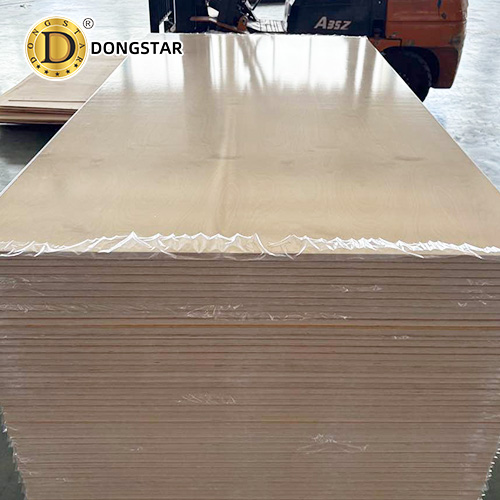
Commercial Plywood
Commercial plywood is commonly offered in:
- 1220×2440 mm
- 1250×2500 mm
- 1250×3000 mm
- Customized dimensions
Dongstar’s commercial plywood product data lists these formats and thicknesses ranging from approximately 2.7 to 40 mm depending on specification.
Typical applications include:
- Furniture
- Cabinets
- Interior decoration
- Packaging
- General construction
Film Faced Plywood
For formwork, common sizes include:
- 1220×2440 mm
- 1250×2500 mm
- 1500×3000 mm
- Other project-specific formats
Dongstar’s current product specification also lists 9, 12, 15, 18, 21 and 24 mm options depending on the product configuration.
Marine Plywood
Marine plywood should be specified by the relevant performance standard rather than size alone.
A buyer should identify:
- Required standard
- Wood species
- Face/back grade
- Core construction
- Glue system
- Thickness
- Dimensions
- Certification requirements
Birch Plywood
Birch plywood is frequently purchased for furniture, CNC machining and interior products.
The appropriate sheet size depends heavily on the customer’s cutting equipment and component dimensions.
How Plywood Thickness Changes the Specification
Sheet dimensions tell you the length and width.
Thickness tells you how the panel will perform.
Common plywood thicknesses include:
| Thickness | Typical Application |
|---|---|
| 3 mm | Backing, decorative panels |
| 6 mm | Cabinet backs, lightweight components |
| 9 mm | Furniture components, partitions |
| 12 mm | Cabinets, furniture, panels |
| 15 mm | Furniture, flooring, construction |
| 18 mm | Cabinets, flooring, construction |
| 21 mm | Heavy-duty furniture and construction |
| 24–25 mm | Heavy-duty applications |
The correct thickness depends on the load, span, support structure, fastening system and product type.
For example, an 18 mm commercial plywood panel and an 18 mm film faced plywood panel are not automatically interchangeable.
They can have different:
- Core structures
- Face materials
- Glue systems
- Surface treatments
- Performance requirements
So don’t quote plywood using dimensions alone.
A complete specification should combine size + thickness + grade + core + glue + surface + applicable standard.
Nominal vs Actual Plywood Dimensions
This is one of the most important details for professional buyers.
A panel may be sold as 4×8, but its actual finished size can be slightly different.
Likewise, a plywood product described as 18 mm may have a permitted manufacturing tolerance.
Why?
Because plywood is manufactured, pressed, trimmed and often sanded.
Dongstar’s existing guide explains that a nominal 4×8 sheet may have an actual dimension slightly below 48×96 inches.
For general construction, a small difference may not matter.
For precision furniture production, it can.
Buyers Should Confirm
Before mass production, request:
- Nominal dimensions
- Actual finished dimensions
- Length tolerance
- Width tolerance
- Thickness tolerance
- Squareness tolerance
- Flatness requirements
This is particularly important when the plywood will go directly into automated cutting or CNC production.
A reliable supplier should be able to explain its dimensional tolerances clearly.
How to Choose the Right Plywood Sheet Size
Don’t start with the supplier’s catalog.
Start with your application.
Ask four questions.
1. What component are you making?
A cabinet manufacturer may need a size that matches its cutting optimization.
A construction contractor may prioritize easy handling.
A formwork company may prioritize large coverage and repeat use.
2. What equipment are you using?
If your CNC table is designed around 1220×2440 mm, changing to 1250×2500 mm may require an equipment adjustment.
3. How much waste will the size create?
A slightly larger sheet may reduce offcuts.
But if the extra material can’t be used, you may simply be paying for material that becomes waste.
4. How will the sheets be transported?
Larger panels require more careful handling and packaging.
For importers, container loading should be considered before approving a new sheet size.
How Sheet Size Affects Cutting Waste
This is where experienced buyers often gain an advantage.
Suppose a furniture manufacturer needs components that are 600 × 800 mm.
A standard 1220×2440 mm sheet may provide a different cutting yield from a 1250×2500 mm sheet.
The larger sheet isn’t automatically more economical.
The correct comparison is:
Purchase price + cutting yield + waste + labor + handling
rather than simply:
Price per sheet
This is why a professional plywood supplier should be able to discuss the customer’s application rather than simply sending a generic price list.
For large projects, ask the supplier or your own production team to prepare a cutting layout before selecting a non-standard dimension.
A two-minute conversation about sheet utilization can sometimes save considerably more than negotiating a few cents off the unit price.
How Plywood Dimensions Affect Container Loading
For global B2B buyers, plywood dimensions are also a logistics issue.
The sheet’s length and width affect:
- Pallet footprint
- Number of sheets per pallet
- Warehouse space
- Container arrangement
- Loading efficiency
- Handling equipment
Thickness affects the number of sheets that can be stacked.
For example, changing from 12 mm to 18 mm significantly changes the volume occupied by the same number of sheets.
Weight can also become important.
Dongstar’s 4×8 plywood weight guide notes that plywood weight varies with thickness, wood density, glue content and moisture level.
For a container order, therefore, the supplier should provide a realistic loading plan.
Ask for:
- Sheets per pallet
- Pallet dimensions
- Pallets per container
- Gross weight
- Net weight
- Container type
- Loading method
This lets you estimate the real landed cost, not just the factory price.
Custom Plywood Sizes: When Do You Need Them?
Custom plywood dimensions make sense when standard sheets create excessive waste or don’t fit the production process.
They can be useful for:
- Large construction panels
- Furniture factories
- CNC manufacturing
- Specialty packaging
- Large formwork systems
- OEM projects
But custom sizes usually require more planning.
The factory may need to consider:
- Veneer availability
- Press dimensions
- Trimming
- Production efficiency
- Minimum order quantity
- Packaging
- Container utilization
Dongstar’s commercial plywood product information explicitly indicates that customized sizes can be produced according to requirements.
For a first order, however, standard dimensions are usually easier to source and compare.
If you’re considering a custom size, ask for both:
Standard size quotation
and
Custom size quotation
Then compare the total cost.
What Global Buyers Should Put in a Plywood RFQ
A good RFQ eliminates unnecessary back-and-forth.
Instead of:
“Please quote 4×8 plywood.”
send:
Commercial plywood, 1220×2440×18 mm, specified face/back grade, specified core, MR/WBP glue, sanding requirement, quantity, packaging requirement and destination port.
For a serious B2B inquiry, include:
| Specification | Example |
|---|---|
| Product | Commercial plywood |
| Size | 1220×2440 mm |
| Thickness | 18 mm |
| Tolerance | As agreed |
| Face/back | B/BB, BB/CC, etc. |
| Core | Poplar, hardwood, eucalyptus, etc. |
| Glue | MR, WBP, etc. |
| Market-specific requirement | |
| Surface | Sanded / unsanded |
| Quantity | Sheets / CBM / containers |
| Packaging | Export standard |
| Destination | Port + country |
| Certification | Required certificates |
This approach makes supplier comparisons much more meaningful.
Dongstar’s supplier-evaluation article recommends comparing core material, glue, veneer grade, certifications, thickness tolerance, packaging and other specifications instead of judging suppliers solely by price.
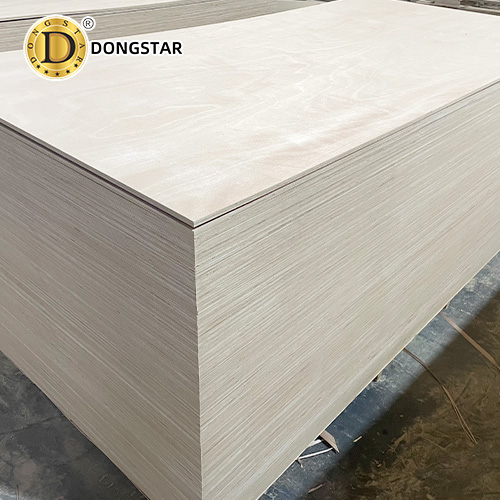
Why Buy Standard Plywood Sizes from a China Factory?
China is an important sourcing market for plywood because buyers can access a broad manufacturing base, multiple panel types and different specifications.
Dongstar identifies its plywood operation in Linyi, Shandong, and its product range includes commercial plywood, film faced plywood, marine plywood and other wood panels.
For global buyers, the advantage isn’t simply factory price.
A capable China plywood factory can potentially support:
- Standard 4×8 production
- Metric sheet dimensions
- Customized sizes
- Multiple thicknesses
- Different core materials
- OEM packaging
- Container-scale orders
But buyers should verify capability before placing a large order.
Dongstar’s own supplier guide recommends checking factory capacity, production equipment, samples, quality systems, certifications and communication rather than choosing a supplier based solely on a low quotation.
Why Consider Dongstar for Bulk Plywood?
For a global importer, the supplier’s ability to consistently reproduce the approved specification is often more important than a one-time low price.
Dongstar’s official product information shows standard formats including 1220×2440 mm and 1250×2500 mm, with customized sizes available for commercial plywood.
Its film faced plywood specifications also cover 1220×2440 mm, 1250×2500 mm and larger formats, with different thicknesses, core options, films and glue systems available depending on the specification.
For project buyers, wholesalers and importers, the useful questions are:
- Can the supplier produce my required dimensions consistently?
- Can the factory maintain thickness tolerance?
- Can it provide the required core?
- Can it support my packaging requirements?
- Can it load containers efficiently?
- Can it provide samples before bulk production?
- Can it support repeat orders?
Those questions matter far more than simply asking:
“What is your cheapest 4×8 plywood?”
For bulk sourcing, you can review Dongstar’s China plywood product range and use the complete specification above when requesting a quotation.
Frequently Asked Questions About Plywood Sheet Sizes
What is the standard plywood sheet size?
The most widely recognized standard is 4×8 ft, approximately 1220×2440 mm. It is widely used in construction, furniture, cabinets and general woodworking.
What are 4×8 plywood sheet dimensions?
A nominal 4×8 plywood sheet is 48×96 inches, approximately 1220×2440 mm.
Is 1220×2440 mm exactly the same as 4×8?
It is the commonly used metric equivalent, but actual finished dimensions and manufacturing tolerances should be confirmed with the supplier.
What other standard plywood sizes are available?
Common alternatives include 1220×1220 mm, 1525×1525 mm, 1220×3050 mm, 1525×3050 mm and metric formats such as 1250×2500 mm. Availability varies by manufacturer and product.
What plywood size is best for furniture manufacturing?
There isn’t one universal answer. The best size is the one that fits the furniture components and cutting equipment while minimizing waste.
What plywood size is commonly used for construction?
4×8 plywood is widely used because it offers a practical balance between coverage, handling and compatibility with many construction systems.
Can I order custom plywood dimensions from China?
Yes. Some Chinese plywood manufacturers can supply customized dimensions, depending on product type, production capability and order quantity. Dongstar’s commercial plywood information states that customized sizes are available.
Does plywood thickness affect sheet size?
Thickness doesn’t normally change the nominal length and width, but it changes sheet weight, volume, pallet capacity and container loading.
How should an importer specify plywood dimensions?
Give the supplier the exact length and width in millimeters, thickness, tolerance, grade, core, glue, surface requirements, quantity and destination.
Which is better: 1220×2440 or 1250×2500 plywood?
Neither is automatically better. Choose based on the project’s cutting plan, equipment, waste rate, handling requirements and total delivered cost.
Final Buying Checklist
Before ordering a container of plywood, confirm these points:
Dimensions
Length
Width
Unit: mm or inches
Nominal versus actual size
Dimensional tolerance
Thickness
Required thickness
Thickness tolerance
Calibration/sanding requirement
Quality
Face/back grade
Core material
Core construction
Glue type
Moisture requirement
Applicable standard
Certification
Logistics
Sheets per pallet
Pallet dimensions
Container loading
Gross weight
Net weight
Export packaging
Commercial Terms
MOQ
Factory price
Incoterm
Production lead time
Sample approval
Inspection procedure
The most important lesson is simple:
Don’t purchase plywood by “4×8″ alone.
Specify the complete product.
For many buyers, 1220×2440 plywood remains the practical starting point. But depending on the project, 1250×2500 mm, 1250×3000 mm or another format may provide better material utilization.
The right plywood sheet dimension is ultimately the one that works best across the entire supply chain—from factory production and cutting to container loading and final installation.
For global project buyers, wholesalers and importers, that small difference in specification can have a surprisingly large impact on the final cost.
Recommended Reading from Dongstar Blog
- What is Plywood? Complete Guide for Importers in 2026
- Plywood Sizes & Thickness: Standard Sheet Dimensions Guide 2026
- OSB vs Particle Board: 2026 Comparison for Global Buyers | China Supplier Guide
- 7/16 OSB Board Weight and 7/16 OSB Price Guide 2026 | OSB Supplier China
- How Much Does a 4×8 Sheet of 1/2 Plywood Weigh? | 1/2 Plywood Weight Guide 2026
- Plywood Price per Sheet in 2026 | China Plywood Price Guide for Global Buyers
- How to Negotiate Plywood Prices with Chinese Factories: 12 Proven Strategies to Reduce Costs Without Sacrificing Quality
- China vs Vietnam Plywood: Which is Better for Importers in 2026?
Post time: Aug-18-2026