
Table of Contents
- What Is OSB Board?
- What Is Particle Board?
- OSB vs Particle Board: Main Differences
- Strength and Durability Comparison
- Applications: Construction vs Furniture
- OSB Board Price vs Particle Board Price
- How to Choose the Right Supplier
- Why Buy OSB and Particle Board from China?
- Why Choose Dongstar Wood Panels?
- Frequently Asked Questions
When selecting engineered wood panels for construction, furniture manufacturing, or interior projects, many buyers compare OSB vs Particle Board before making a purchasing decision.
Both materials are widely used around the world, but they are designed for different purposes.
For professional importers and distributors, choosing between China OSB Board and China Particle Board is not simply a matter of price. The right choice depends on:
- Required strength
- Application environment
- Project budget
- Processing requirements
- Transportation cost
- Long-term performance
OSB and Particle Board are both engineered wood products, but their structure, manufacturing process, and performance characteristics are different.
This guide explains the differences between OSB and Particle Board to help global buyers select the right material and source from reliable suppliers.
What Is OSB Board?
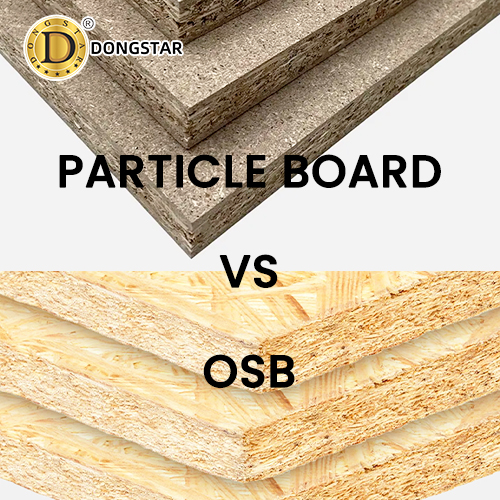
OSB, also known as Oriented Strand Board, is an engineered wood panel made from large wood strands arranged in specific directions and bonded together with resin under high pressure and temperature.
The strand orientation creates a strong panel structure with excellent mechanical performance.
Unlike traditional particle-based panels, OSB uses longer wood strands, which improves:
- Strength
- Impact resistance
- Structural stability
- Load-bearing capability
OSB Manufacturing Process
The production process generally includes:
- Selecting wood materials
- Cutting logs into strands
- Drying wood strands
- Applying adhesive
- Orienting strands into layers
- Hot pressing panels
- Cutting and finishing
The layered structure is what gives OSB better strength compared with many conventional particle boards.
Common OSB Types
Professional buyers may choose different OSB grades:
OSB1
Used for:
- Indoor furniture
- Dry environments
OSB2
Used for:
- General construction
- Load-bearing applications in dry conditions
OSB3
Used for:
- Moisture-resistant construction
- Structural applications
OSB/4
Used for:
- Heavy-duty structural projects
For international markets, OSB/3 is one of the most commonly requested grades.
What Is Particle Board?
Particle Board, also called chipboard, is an engineered wood panel made from small wood particles, chips, and sawdust bonded together with resin.
It is one of the most widely used materials in furniture manufacturing because it provides a cost-effective alternative to natural wood.
Particle Board is commonly used for:
- Flat-pack furniture
- Cabinets
- Office furniture
- Shelving
- Decorative panels
Particle Board Manufacturing Process
The production process includes:
- Processing wood particles
- Mixing particles with adhesive
- Forming layers
- Hot pressing
- Surface finishing
Modern particle boards can achieve excellent surface quality when combined with:
- Melamine paper
- Veneer
- Laminate surfaces
Why Particle Board Is Popular
The main advantages include:
- Lower cost
- Smooth surface
- Easy machining
- Good appearance after lamination
- Efficient material utilization
This makes it especially popular among furniture manufacturers.
OSB vs Particle Board: Main Differences
The biggest difference between OSB and Particle Board is the internal structure.
| Feature | OSB Board | Particle Board |
|---|---|---|
| Raw Material | Large oriented wood strands | Small wood particles |
| Strength | Higher | Medium |
| Structural Use | Excellent | Limited |
| Price | Higher | Lower |
| Screw Holding | Better | Average |
| Moisture Resistance | Better grades available | More limited |
| Furniture Use | Growing | Very common |
| Construction Use | Widely used | Limited |
Strength and Durability: Which Performs Better?
If the decision comes down to strength, OSB vs Particle Board is not really a close contest.
OSB is generally the better choice for applications where the panel needs to carry loads, resist racking, or maintain structural performance. Its long wood strands are oriented in layers, creating a more engineered internal structure.
Particle Board is made from smaller wood particles. It can perform very well in the right furniture application, but it isn’t normally the first choice for demanding structural work.
For a project buyer, the practical rule is simple:
Choose OSB when structural performance matters. Choose Particle Board when cost, surface finish, and furniture applications matter more.
Screw-Holding Performance
OSB generally has better fastener-holding performance because of its strand structure.
This matters when panels need to be:
- Fastened repeatedly
- Attached to timber frames
- Used for structural sheathing
- Installed in applications subject to movement
Particle Board can still work well with appropriate screws and edge distances, especially in cabinet and furniture production. However, the material needs to be specified for the intended use rather than treated as a direct substitute for OSB.
Moisture Resistance
Neither standard OSB nor standard Particle Board should automatically be considered waterproof.
The grade, adhesive system, edge protection, surface treatment, and exposure conditions all matter.
Dongstar’s OSB product information, for example, distinguishes between OSB grades and adhesive systems, including OSB3 products intended for more demanding environments.
For an importer, this leads to an important purchasing rule:
Never order simply by saying “OSB” or “Particle Board.” Specify the grade, thickness, adhesive requirement, emission standard, and intended application.
Applications: Construction vs Furniture
The easiest way to choose between OSB and Particle Board is to start with the final application.
OSB for Construction
OSB is widely used for:
- Roof decking
- Wall sheathing
- Flooring systems
- Structural panels
- Prefabricated construction
- Packaging and industrial crates
Dongstar’s existing OSB guidance identifies roofing, wall sheathing, flooring, and packaging among the major applications for OSB.
For construction buyers, OSB is attractive because its engineered strand structure provides a good balance of strength, dimensional stability, and production consistency.
Particle Board for Furniture
Particle Board is especially common in:
- Wardrobes
- Office furniture
- Shelving
- Cabinet carcasses
- Flat-pack furniture
- Retail fixtures
Its smooth, uniform surface also makes it a practical substrate for decorative finishes such as melamine paper and laminates.
This is one reason China Particle Board remains an important sourcing category for furniture manufacturers and wholesalers.
What About Cabinets?
Cabinet manufacturing is where the decision becomes more application-specific.
A high-volume furniture factory may use:
- Particle Board for cabinet carcasses
- MDF for painted doors
- Plywood for high-strength cabinet structures
- Melamine-faced panels for finished surfaces
In other words, there isn’t one “best” wood panel for every cabinet.
Dongstar’s existing kitchen cabinet comparison reaches a similar conclusion: Particle Board can be a cost-effective cabinet material when protected from moisture, while plywood offers greater structural strength and MDF is often preferred for painted doors.
OSB vs Particle Board: B2B Buyer Comparison
For importers comparing quotations from different factories, the following table provides a practical starting point.
| Factor | OSB Board | Particle Board |
|---|---|---|
| Main raw material | Oriented wood strands | Wood particles/chips |
| Structural strength | High | Moderate |
| Screw holding | Generally better | Moderate |
| Surface finish | Textured/industrial | Smooth and uniform |
| Furniture applications | Good | Excellent |
| Structural construction | Excellent | Limited |
| Roof and wall sheathing | Common | Generally unsuitable |
| Cabinet carcasses | Possible | Very common |
| Decorative laminating | Possible | Excellent |
| Moisture-resistant grades | Available | Available, depending on specification |
| Typical positioning | Performance/structural | Cost-effective furniture panel |
| Price positioning | Usually higher | Usually lower |
| Best buyer | Construction/project buyer | Furniture/distribution buyer |
The important point is that price should not be compared without comparing specifications.
A cheaper Particle Board quotation isn’t necessarily cheaper if the project actually requires the structural performance of OSB.
Likewise, buying OSB for a simple indoor furniture application may add cost without providing a meaningful benefit.
OSB Board Price vs Particle Board Price
Price is one of the first questions asked by importers, but it is also one of the easiest areas to compare incorrectly.
There is no single fixed international price for either OSB or Particle Board. Factory quotations can change according to:
- Thickness
- Density
- Board size
- Grade
- Glue system
- Emission standard
- Surface treatment
- Certification
- Packaging
- Order quantity
- Destination
- Shipping conditions
For example, a buyer comparing an 18 mm OSB3 panel with an 18 mm raw Particle Board panel is not making an apples-to-apples comparison.
A more useful calculation is:
Total landed cost = Product cost + Freight + Insurance + Duties + Port/handling costs
For large-volume buyers, the cost per usable square meter is often more useful than the price per sheet.
Why the Lowest Factory Price Can Be Misleading
Suppose Supplier A offers a lower price but uses:
- Lower density
- Different glue
- Less protective packaging
- Higher thickness tolerance
- Lower certification level
Supplier B may initially look more expensive, yet produce a lower total cost after accounting for:
- Fewer damaged panels
- Better installation performance
- Lower rejection rates
- More predictable container loading
- Fewer quality claims
This is why experienced importers compare the complete specification sheet, not just the first quotation.
How to Choose the Right China OSB Board or Particle Board Supplier
When sourcing from China, buyers often receive quotations from trading companies, exporters, and manufacturers.
The challenge isn’t finding a quotation.
The challenge is determining whether the supplier can repeatedly deliver the same product to the required specification.
1. Confirm the Factory’s Product Range
A supplier that manufactures multiple engineered wood products may offer a more convenient sourcing solution.
Dongstar’s official product range currently includes OSB Board, Particle Board, MDF Board, Melamine Board, Plywood, and Film Faced Plywood.
For a buyer sourcing several product categories, this can simplify:
- Supplier management
- Container planning
- Quality communication
- Documentation
- Repeat orders
2. Request a Technical Specification Sheet
Before discussing price, provide the supplier with:
- Product type
- Thickness
- Size
- Grade
- Density
- Glue requirement
- Emission requirement
- Surface requirement
- Quantity
- Destination port
This avoids the classic problem of receiving a low quotation for a product that doesn’t actually meet the project specification.
3. Check Production Consistency
Ask how the factory controls:
- Thickness tolerance
- Density
- Moisture
- Surface quality
- Bonding performance
- Edge condition
For bulk orders, consistency is often more valuable than a small difference in unit price.
4. Confirm Container Loading
Ask for a proposed packing and loading plan before placing the order.
The supplier should be able to explain:
- Sheets per pallet
- Pallets per container
- Net weight
- Gross weight
- Packaging dimensions
This information helps importers calculate the real landed cost.
5. Ask for Samples
A sample can reveal things that a quotation cannot.
Check:
- Surface quality
- Edge quality
- Thickness
- Density
- Cutting performance
- Smell
- Color
- Screw holding
For larger projects, third-party inspection can provide another layer of protection.
Why Buy OSB and Particle Board from China?
China has a mature engineered wood panel industry and a large export manufacturing base.
For international buyers, the main advantage isn’t simply low factory pricing. The broader advantage is the combination of:
- Manufacturing scale
- Product variety
- OEM capability
- Export infrastructure
- Flexible specifications
- Container-scale production
Dongstar states that its group was founded in the 1990s in Linyi, Shandong, and has multiple business areas covering wood panel manufacturing and export. Its official product range includes both OSB and Particle Board.
This is particularly useful for B2B customers who don’t want to manage a different supplier for every panel category.
China OSB Board for Construction Buyers
For contractors and project distributors, China OSB Board can be attractive when the required specification, certification, and structural grade are clearly defined.
Dongstar currently lists OSB2 and OSB3 products, with common sizes including 1220 × 2440 mm and thicknesses from 8 mm through 18 mm on its OSB product page.
China Particle Board for Furniture Buyers
For furniture factories and wholesalers, China Particle Board can provide a cost-effective substrate for cabinet and furniture production.
When decorative finishing is required, buyers can also consider melamine-faced panel solutions rather than purchasing raw Particle Board and finishing it separately.
OSB vs Particle Board: Which Should You Choose?
Here’s the short answer.
Choose OSB when:
- Structural strength is important
- The panel will be used for sheathing
- The project involves roofing or flooring
- Better fastener holding is needed
- You are supplying construction projects
- Panel performance is more important than the lowest initial price
Choose Particle Board when:
- The application is primarily furniture
- Cost efficiency is a major priority
- A smooth substrate is needed for decorative finishing
- The panels will be used in dry indoor environments
- You are producing cabinets, shelving, or flat-pack furniture
Consider Plywood Instead When:
- Moisture exposure is a major concern
- High-end furniture requires a veneer appearance
- Higher strength-to-weight performance is needed
- The project specification specifically requires plywood
The right answer isn’t always OSB or Particle Board. For serious B2B buyers, the better approach is to match the panel to the job.
Why Choose Dongstar Wood Panels?
Dongstar’s official website lists a broad range of wood-based panels, including Plywood, Film Faced Plywood, MDF Board, Melamine Board, OSB Board, and Particle Board.
The company says Dongstar Group was founded in the 1990s in Linyi, Shandong, and supplies wooden panels to international markets.
For global B2B buyers, the value of working with an experienced wood-panel supplier is not limited to the factory quotation.
A suitable supplier should be able to help with:
- Product selection
- Technical specifications
- Sample confirmation
- Bulk production
- Export packaging
- Container loading
- Shipping documentation
This matters particularly for importers placing repeat orders. A product that looks good in one shipment but changes specification in the next can create much larger costs than a small difference in the original purchase price.
Frequently Asked Questions About OSB vs Particle Board
Is OSB stronger than Particle Board?
Generally, yes. OSB is engineered from oriented wood strands, giving it better structural and mechanical performance than conventional Particle Board. However, actual performance depends on the grade, thickness, density, adhesive system, and applicable standard.
Is Particle Board cheaper than OSB?
Particle Board is generally positioned as the more economical option, particularly for furniture applications. However, buyers should compare the complete specification rather than price alone.
Is OSB good for furniture?
Yes. OSB can be used for furniture, shelving, tables, storage systems, and other applications where its distinctive appearance and strength are desirable. For highly finished furniture, MDF, plywood, or melamine-faced panels may be more appropriate.
Is Particle Board good for cabinets?
Yes. Particle Board is widely used for cabinet carcasses and furniture, particularly when covered with melamine or another decorative surface. Moisture protection and proper edge sealing are important.
Which is better for construction, OSB or Particle Board?
OSB is generally the better choice for structural construction applications such as wall sheathing, roof decking, and flooring systems, provided the selected grade meets the project specification.
Which is better for furniture, OSB or Particle Board?
Particle Board is often the more practical choice for conventional mass-produced furniture because of its cost and smooth substrate. OSB can be preferable when greater strength or a visible strand appearance is desired.
Is OSB waterproof?
Standard OSB should not automatically be treated as waterproof. Moisture resistance depends on the specific grade, adhesive system, edge treatment, and exposure conditions. Always verify the manufacturer’s technical documentation.
Is Particle Board waterproof?
Standard Particle Board is not waterproof. Moisture-resistant grades are available, but prolonged water exposure can still damage the panel. For wet or exterior applications, a more suitable panel should be specified.
What should I ask a China OSB Board supplier before ordering?
At minimum, ask for:
- Product grade
- Thickness
- Dimensions
- Density
- Glue type
- Formaldehyde emission level
- Certification
- Moisture resistance
- Packing method
- Loading quantity
- Production lead time
Can one Chinese supplier provide both OSB and Particle Board?
Yes. Some manufacturers and exporters supply multiple engineered wood panel categories. Dongstar’s official product range includes both OSB Board and Particle Board, as well as MDF, Melamine Board, and Plywood.
Final Verdict: OSB or Particle Board?
There is no universal winner in the OSB vs Particle Board debate.
For construction and structural applications, OSB is generally the stronger choice.
For cost-sensitive furniture and cabinet production, Particle Board is often the more economical solution.
For international buyers, the smartest decision is to start with the application, then work backward to the specification.
A good purchasing process looks like this:
Application → Required performance → Grade → Thickness → Certification → Quantity → Supplier → Price
Not:
Price → Cheapest supplier → Hope for the best.
That distinction can make a major difference when you’re buying a full container rather than a few sheets.
If you’re sourcing China OSB Board or China Particle Board for a project, wholesale program, or long-term distribution business, ask suppliers for a complete specification sheet and loading proposal before comparing quotations.
That gives you a much clearer picture of the actual value you’re buying.
Recommended Reading from Dongstar Blog
- What is Plywood? Complete Guide for Importers in 2026
- 7/16 OSB Board Weight and 7/16 OSB Price Guide 2026 | OSB Supplier China
- How Much Does a 4×8 Sheet of 1/2 Plywood Weigh? | 1/2 Plywood Weight Guide 2026
- Plywood Price per Sheet in 2026 | China Plywood Price Guide for Global Buyers
- How to Negotiate Plywood Prices with Chinese Factories: 12 Proven Strategies to Reduce Costs Without Sacrificing Quality
- China vs Vietnam Plywood: Which is Better for Importers in 2026?
- Dubai WoodShow 2026: Meet Dongstar at Booth A18 for Premium Plywood, MDF, OSB & Decorative Panels
- What to Check Before Buying Plywood from China: 12 Critical Factors Every Importer Must Know
Post time: Aug-10-2026