

Table of Contents
- What Are the Standard Plywood Sheet Sizes?
- Plywood Dimensions by Market: Imperial vs Metric
- 4×8 Plywood Dimensions: Why 1220 x 2440 mm Is So Common
- Plywood Thickness Chart: Common Sizes in mm and Inches
- Nominal vs Actual Plywood Thickness: What Buyers Need to Know
- How to Choose Plywood Thickness by Application
- Plywood Sizes and Thicknesses by Product Type
- When Should You Buy Oversized or Custom Plywood Sheets?
- Plywood Dimensions, Tolerance and Quality Control
- How Plywood Size and Thickness Affect Container Loading
- How to Order the Correct Plywood Specification from a Supplier
- Why Global Buyers Source Plywood from China
- Why Choose Dongstar for Bulk Plywood Supply?
- Frequently Asked Questions About Plywood Sizes and Thickness
- Final Buying Checklist for Plywood Sizes and Thickness
Plywood Sizes & Thickness: Standard Sheet Dimensions Guide
If you’re buying a few sheets for a workshop, plywood size is fairly easy to understand.
If you’re buying one or more containers for a construction project, furniture factory, wholesale business, or building-material distribution network, it’s a different story.
A difference of only a few millimeters can affect cutting plans, pallet dimensions, container utilization, installation, and even whether the product meets your customer’s specification.
That’s why understanding plywood sheet sizes, plywood dimensions, and plywood thickness is an important part of international plywood purchasing.
The good news is that most plywood specifications are not complicated once you know what to look for.
The familiar 4×8 plywood format remains one of the most widely recognized sheet formats. A nominal 4×8 sheet corresponds to approximately 1220 × 2440 mm, although actual manufactured dimensions and tolerances depend on the applicable standard and supplier specification. Dongstar itself lists 1220 × 2440 mm among its plywood product dimensions.
For B2B buyers, however, sheet length and width are only two pieces of the puzzle.
You also need to consider:
- Thickness
- Grade
- Core construction
- Face/back veneer
- Glue type
- Moisture resistance
- Emission requirements
- Dimensional tolerance
- Packaging
- Loading quantity
- Destination-market standards
Let’s break it down.
What Are the Standard Plywood Sheet Sizes?
The most familiar plywood sheet size in many international markets is 4 × 8 feet, or approximately 1220 × 2440 mm.
A nominal 4×8 sheet has an area of approximately 32 square feet, or about 2.98 square meters.
| Plywood Sheet Size | Imperial Approx. | Metric Approx. | Typical Use |
|---|---|---|---|
| 4 × 8 ft | 48 × 96 in | 1220 × 2440 mm | Construction, furniture, general use |
| 4 × 4 ft | 48 × 48 in | 1220 × 1220 mm | Smaller panels, furniture |
| 5 × 5 ft | 60 × 60 in | 1500 × 1500 mm | Specialty/cabinet applications |
| 4 × 10 ft | 48 × 120 in | Approx. 1220 × 3050 mm | Large projects |
| 5 × 10 ft | 60 × 120 in | Approx. 1525 × 3050 mm | Specialty applications |
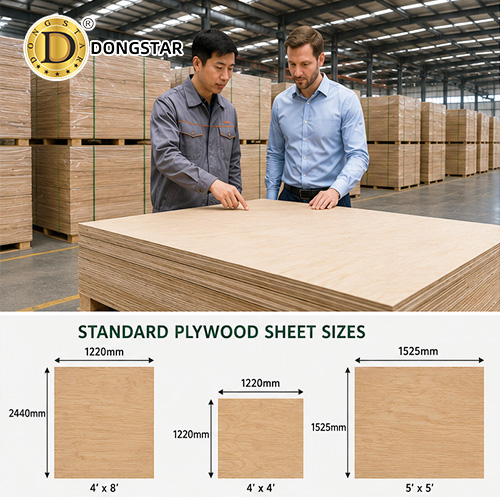
Availability varies by manufacturer, product type, market, and production line. A buyer should therefore treat these as common formats rather than assuming every factory stocks every dimension.
The 4×8 format is especially important for international purchasing because many construction drawings, furniture cutting plans, and material estimates are based around it.
Dongstar’s own recently published guide identifies 4×8 plywood as the most common sheet format and gives 1220 × 2440 mm as its metric equivalent.
For a bulk order, though, “4×8″ isn’t enough information for a factory quotation.
A proper purchase specification should look more like:
Commercial Plywood, 1220 × 2440 × 18 mm, specified face/back grade, specified core, specified glue, specified emission standard, quantity in sheets or containers.
That is much harder to misunderstand.
Plywood Dimensions by Market: Imperial vs Metric
One of the easiest mistakes for international buyers to make is assuming that “4×8″ means exactly the same thing in every market.
In practice, plywood dimensions are influenced by local construction systems, furniture manufacturing practices, standards, equipment, and customer expectations.
North American buyers commonly request 4×8 plywood, while metric markets may communicate the same basic format as 1220 × 2440 mm or 2440 × 1220 mm.
The board itself is the same orientation; the order of the dimensions simply changes.
Other markets may favor formats such as:
- 1250 × 2500 mm
- 1200 × 2400 mm
- 1220 × 2440 mm
- 1500 × 1500 mm
Some European-oriented supply chains use 2500 × 1250 mm formats, while 2440 × 1220 mm remains a familiar international panel dimension. Recent industry guides also show that plywood dimensions vary by market rather than following one universal global sheet size.
Why Does This Matter to Importers?
Imagine a furniture manufacturer has cutting equipment designed around 2440 × 1220 mm sheets.
A supplier offers 2500 × 1250 mm panels at a slightly lower price.
At first glance, that sounds like a good deal.
But if the buyer has to:
- Modify cutting programs
- Change pallet dimensions
- Adjust storage racks
- Change container-loading plans
- Increase trimming waste
the cheaper panel may not actually be cheaper.
Sheet dimensions should always be evaluated against the buyer’s production system.
4×8 Plywood Dimensions: Why 1220 x 2440 mm Is So Common
The popularity of 4×8 plywood is not accidental.
The format works well for many construction and woodworking applications, is familiar to distributors, and provides a practical balance between panel coverage and handling.
A nominal 4×8 panel is:
- 4 feet wide
- 8 feet long
- 48 inches × 96 inches
- Approximately 1220 × 2440 mm
One sheet covers approximately 32 square feet.
That makes estimating relatively simple.
For example, if a project requires approximately 320 square feet of panel area, the theoretical requirement is:
320 ÷ 32 = 10 sheets
In real purchasing, you should add an allowance for:
- Cutting waste
- Damaged sheets
- Openings
- Trim pieces
- Project-specific layout
The actual requirement therefore depends on the cutting plan rather than area alone.
What About the “Actual” 4×8 Size?
A label saying “4×8″ does not necessarily mean the finished panel will measure exactly 48 × 96 inches.
Manufacturing processes, trimming, sanding, and applicable tolerances can result in slightly different finished dimensions.
Dongstar’s current 4×8 plywood guide, for example, notes a typical actual dimension around 47-7/8 × 95-7/8 inches for some panels. That should be treated as an example rather than a universal measurement for every plywood product.
For a project where exact fit matters, the buyer should specify the permitted dimensional tolerance with the supplier.
Plywood Thickness Chart: Common Sizes in mm and Inches
Thickness is where many purchasing problems begin.
The most common plywood thickness options vary by product and market, but international buyers frequently encounter specifications such as:
| Nominal Thickness | Approx. Metric Equivalent | Common Applications |
|---|---|---|
| 1/8 in | 3 mm | Lightweight panels, backing |
| 1/4 in | 6 mm | Cabinet backs, decorative panels |
| 3/8 in | 9 mm | Furniture components, partitions |
| 1/2 in | 12 mm | Cabinets, shelving, wall panels |
| 5/8 in | 15 mm | Flooring, structural applications |
| 3/4 in | 18 mm | Furniture, flooring, construction |
| 7/8 in | 21–22 mm | Heavy-duty applications |
| 1 in | 24–25 mm | Heavy-duty construction |
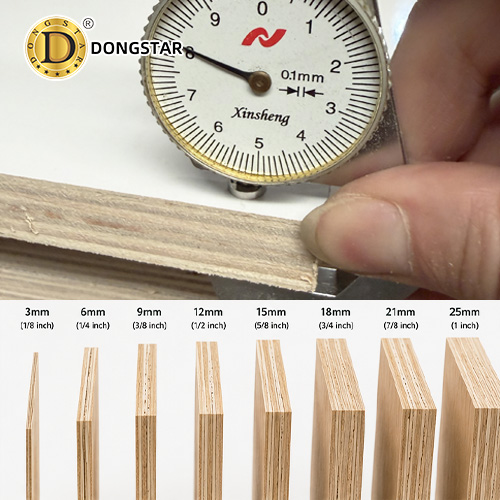
These are useful purchasing references, but inch-to-millimeter conversions are not always exact product specifications.
For example, 3/4 inch mathematically equals 19.05 mm, while a plywood product marketed as “18 mm” is a different nominal metric specification.
That’s why buyers should not automatically convert one market’s nominal thickness into another market’s specification.
Instead, state the required thickness in the format your market uses and ask the supplier to confirm the actual specification.
Common Commercial Plywood Thicknesses
For furniture and general construction, 12 mm and 18 mm are particularly common specifications.
Common Film Faced Plywood Thicknesses
Film faced plywood is frequently specified around 12, 15, and 18 mm, although available options vary by manufacturer and application.
Common Marine Plywood Thicknesses
Marine plywood can be supplied in a range of thicknesses depending on structural requirements and the applicable standard.
The important point is that thickness alone does not determine plywood quality.
Two 18 mm sheets can have very different:
- Core construction
- Density
- Bonding quality
- Face veneer
- Moisture performance
- Strength
Nominal vs Actual Plywood Thickness: What Buyers Need to Know
This is one of the most useful details to understand before buying plywood.
A sheet may be sold as 3/4-inch plywood, but its measured thickness may be lower than exactly 19.05 mm.
Why?
Plywood manufacturing can involve:
- Veneer thickness variation
- Hot pressing
- Sanding
- Calibration
- Finishing
- Production tolerances
Dongstar’s existing plywood dimensions guide gives the familiar example of 3/4-inch plywood being approximately 23/32 inch actual thickness in some products.
For an importer, the practical lesson is simple:
Do not assume nominal thickness equals actual measured thickness.
If the plywood will be used for precision machining, CNC processing, flooring systems, or furniture joinery, ask for the permitted tolerance.
International standards also treat dimensions and tolerances as part of plywood specification. ISO 12465, for example, covers plywood specifications including dimensions, tolerances, veneer quality, glue bonding, lay-up, verification, and marking.
For technical procurement, buyers can also consult the relevant standard for their market and application. ISO 12465:2007 — Plywood Specifications
How to Choose Plywood Thickness by Application
There’s no universal “best plywood thickness.”
The correct thickness depends on what the sheet has to do.
6 mm Plywood
Commonly considered for:
- Cabinet backs
- Decorative panels
- Lightweight partitions
- Interior lining
It is useful when low weight is more important than high load-bearing capacity.
9–12 mm Plywood
Often used for:
- Furniture components
- Cabinet structures
- Wall panels
- Packaging
- Interior construction
15 mm Plywood
A useful middle-ground specification for applications that require more rigidity than 12 mm.
Depending on the grade and structural design, it can be used for:
- Flooring systems
- Furniture
- Construction components
- Packaging
18 mm Plywood
One of the most important B2B plywood thicknesses.
It is widely considered for:
- Heavy-duty furniture
- Cabinet carcasses
- Flooring
- Structural panels
- Construction projects
- Formwork applications
21–25 mm Plywood
These thicker panels are generally selected when the project requires additional stiffness, load capacity, or durability.
For structural applications, however, thickness should never be selected by rule of thumb alone. Span, support spacing, load, panel grade, fastening method, and applicable building requirements all matter.
Plywood Sizes and Thicknesses by Product Type
Not all plywood follows exactly the same purchasing pattern.
Commercial Plywood
Typical B2B specifications include:
- 1220 × 2440 mm
- 6–18 mm
- Different hardwood or softwood cores
- Various face grades
- MR or other specified glue systems
Commercial plywood is widely used for furniture, interior decoration, cabinets, packaging, and general construction.
Film Faced Plywood
Common specifications include:
- 1220 × 2440 mm
- 1250 × 2500 mm
- 12–18 mm
- Phenolic film surfaces
- Different core materials
For formwork buyers, the panel thickness, film quality, edge sealing, core construction, and reuse expectations should all be included in the specification.
Marine Plywood
Marine plywood is generally purchased according to a much stricter performance requirement than ordinary commercial plywood.
The buyer should specify:
- Standard
- Wood species
- Face/back grade
- Core construction
- Glue/bonding requirement
- Thickness
- Size
- Certification
Simply asking for “marine plywood” without defining the applicable standard can lead to different products being quoted.
Birch Plywood
Birch plywood is often sold in formats such as 1220 × 2440 mm and 1500 × 1500 mm, depending on the supplier and target market.
Its common applications include:
- Furniture
- CNC components
- Cabinets
- Interior products
- Industrial components
When Should You Buy Oversized or Custom Plywood Sheets?
A standard 4×8 panel isn’t always the most economical option.
Oversized sheets can make sense when the project has:
- Large uninterrupted surfaces
- Tall wall panels
- Long furniture components
- Large formwork panels
- Fewer-joint requirements
For example, using a larger panel may reduce the number of joints in a wall or decorative installation.
But larger sheets can also create problems.
They may require:
- Special handling equipment
- Larger storage areas
- Different container loading
- More workers during installation
- Modified cutting equipment
So don’t automatically choose the largest available sheet.
The best sheet size is the one that minimizes total project cost, not necessarily the one with the most square meters.
Plywood Dimensions, Tolerance and Quality Control
For a small DIY job, a minor size difference may not matter.
For a factory purchasing 20 or 30 containers, it can become a serious production issue.
That’s why B2B buyers should include dimensional tolerances in their purchase specification.
Important measurements include:
- Length
- Width
- Thickness
- Squareness
- Flatness
A professional quality inspection should also examine:
- Core gaps
- Delamination
- Surface defects
- Veneer repairs
- Warping
- Moisture content
- Edge condition
ISO standards recognize dimensions and tolerances as part of plywood specification, reinforcing the point that size should be treated as a technical requirement rather than a casual description.
A Practical Inspection Approach
Before bulk production:
- Approve the product specification.
- Approve a physical sample.
- Measure sample dimensions.
- Confirm the acceptable tolerance.
- Confirm the test method.
- Include the specification in the purchase contract.
- Conduct pre-shipment inspection for large orders.
This simple process can prevent many avoidable disputes.
How Plywood Size and Thickness Affect Container Loading
This is a topic retail articles often overlook, but it matters greatly to B2B buyers.
A plywood supplier doesn’t just need to know how many sheets you want.
They need to know:
- Sheet dimensions
- Thickness
- Sheets per pallet
- Pallet dimensions
- Packaging method
- Container type
- Destination
- Weight limitations
Thickness directly affects the number of sheets that can be loaded.
For example, an 18 mm panel occupies significantly more volume than a 6 mm panel.
That means a buyer changing from 12 mm to 18 mm without changing the required quantity can materially affect:
- Container utilization
- Freight cost per sheet
- Warehouse space
- Total landed cost
Sheet Size Also Matters
A 1220 × 2440 mm panel and a 1250 × 2500 mm panel have different pallet footprints.
If your warehouse racking or production line is designed for one format, switching sizes can create unexpected handling costs.
For container-scale procurement, ask the supplier for a loading plan before finalizing the order.
That’s a small step that can save a surprising amount of money.
How to Order the Correct Plywood Specification from a Supplier
When requesting a quotation, avoid sending only:
“Please quote plywood 18 mm.”
That’s too vague.
Instead, provide a complete specification.
Recommended B2B RFQ Format
| Item | Example |
|---|---|
| Product | Commercial Plywood |
| Size | 1220 × 2440 mm |
| Thickness | 18 mm |
| Core | Poplar / Hardwood / specified core |
| Face | B/B or required grade |
| Back | B/B or required grade |
| Glue | MR / WBP / specified |
| Emission | Required market standard |
| Sanding | Double-sided sanded |
| Quantity | 1 × 40HQ / specified sheets |
| Packaging | Export standard |
| Destination | Port / country |
| Certification | Required documents |
This allows different factories to quote the same product.
And that’s the key.
A fair price comparison is only possible when the specifications are comparable.
This is particularly important when comparing several China plywood suppliers.
Dongstar’s supplier-evaluation guidance also recommends comparing core material, glue type, veneer grade, certifications, moisture content, thickness tolerance, packaging, and other factors rather than looking only at the headline unit price.
Why Global Buyers Source Plywood from China
China remains an important sourcing base for international plywood buyers because its manufacturing industry can support a wide range of panel types, specifications, and export quantities.
Dongstar states that its group was established in Linyi, Shandong, in the 1990s and identifies plywood, film faced plywood, MDF, OSB, Particle Board, and other wood panels among its product categories.
For importers, the attraction is not simply factory price.
A mature supply base can offer:
- Multiple plywood types
- Large-volume production
- OEM specifications
- Different sheet sizes
- Different thicknesses
- Export packaging
- Container-scale supply
The better approach is to use China’s manufacturing flexibility to match the exact needs of your market.
Why Choose Dongstar for Bulk Plywood Supply?
Dongstar’s official website presents the company as a China-based wood panel manufacturer and supplier with its operations in Linyi, Shandong. Its product portfolio includes Plywood, Film Faced Plywood, Fancy Plywood, MDF Board, OSB Board, Particle Board, Melamine Board, and other panel products.
Visit Dongstar’s official website
For global B2B buyers, the useful question isn’t simply “Can this supplier sell plywood?”
Almost any plywood exporter can answer yes.
The better questions are:
- Can the supplier maintain the same dimensions from shipment to shipment?
- Can it produce the required thickness?
- Can it support different plywood grades?
- Can it provide the required technical documents?
- Can it handle container-volume orders?
- Can it support customized packaging?
- Can it communicate clearly about production and shipment?
These are the factors that determine whether a supplier is useful for a long-term purchasing program.
Dongstar’s current product information includes plywood formats such as 1220 × 2440 mm and positions the company around international wood-panel supply.
For buyers preparing a bulk RFQ, the most efficient next step is to send the supplier the complete specification rather than asking for a general plywood price.
Frequently Asked Questions About Plywood Sizes and Thickness
What is the most common plywood sheet size?
The most widely recognized format is 4×8 feet, approximately 1220 × 2440 mm. It is commonly used in construction, furniture, cabinets, and general woodworking.
What are the standard plywood sheet sizes?
Common formats include 4×8 ft, 4×4 ft, 5×5 ft, and larger specialty formats such as 4×10 ft or 5×10 ft. Availability depends on the supplier, product type, and market.
What are the most common plywood thicknesses?
Common specifications include approximately 3, 6, 9, 12, 15, and 18 mm, with thicker panels available for heavy-duty applications. Exact availability varies by product.
What thickness plywood is best for cabinets?
For many cabinet applications, 12 mm and 18 mm are common choices, but the correct thickness depends on cabinet construction, span, load, hardware, and whether the plywood is used for the carcass, doors, shelves, or backing.
Is 18 mm plywood the same as 3/4-inch plywood?
Not exactly. 3/4 inch equals 19.05 mm mathematically, while 18 mm is a metric product specification. Buyers should state the required nominal specification rather than assuming the two are interchangeable.
What are 4×8 plywood dimensions in millimeters?
A nominal 4×8 plywood sheet is approximately 1220 × 2440 mm. Actual finished dimensions can vary according to manufacturing tolerances and the applicable specification.
Can plywood be ordered in custom dimensions?
Yes. Some manufacturers can produce or cut custom dimensions, depending on product type and order quantity. Custom sizes should be confirmed before placing the order.
Does plywood thickness affect shipping cost?
Yes. Thickness affects the number of sheets that can fit into a given volume and therefore influences container utilization, pallet configuration, and freight cost per sheet.
Should I specify plywood dimensions in inches or millimeters?
Use the unit system required by your market and project. For international factory purchasing, it is often best to provide both, such as 4×8 ft / 1220×2440 mm, to eliminate ambiguity.
How should importers compare plywood sizes from different suppliers?
Ask every supplier to quote the same:
- Length
- Width
- Thickness
- Tolerance
- Grade
- Core
- Glue
- Surface specification
- Quantity
Only then is the price comparison meaningful.
Final Buying Checklist for Plywood Sizes and Thickness
Understanding plywood sizes and thicknesses sounds simple until you’re responsible for a container, a production line, or an entire construction project.
The most important takeaway is this:
Don’t buy plywood by thickness or sheet size alone. Buy it by complete specification.
Before confirming an international plywood order, check:
Sheet Dimensions
Length
Width
4×8 or metric format
Custom-size requirements
Plywood Thickness
Nominal thickness
Actual thickness
Permitted tolerance
Product Specification
Plywood type
Core material
Face/back grade
Glue type
Moisture requirement
Emission standard
Certification
Logistics
Sheets per pallet
Pallet dimensions
Container loading plan
Gross/net weight
Packaging
Destination port
Supplier Verification
Factory capability
Sample approval
Quality inspection
Production lead time
Export experience
For global project buyers, wholesalers, furniture manufacturers, and importers, the right plywood sheet sizes can reduce waste, simplify production, improve container utilization, and prevent costly specification disputes.
And while 4×8 plywood remains the workhorse format in many markets, there is no single plywood size or thickness that is right for every project.
The best specification is the one that matches the application, production process, local market, and total landed cost.
For bulk sourcing, start with the specification—not the price.
Recommended Reading from Dongstar Blog
- What is Plywood? Complete Guide for Importers in 2026
- OSB vs Particle Board: 2026 Comparison for Global Buyers | China Supplier Guide
- 7/16 OSB Board Weight and 7/16 OSB Price Guide 2026 | OSB Supplier China
- How Much Does a 4×8 Sheet of 1/2 Plywood Weigh? | 1/2 Plywood Weight Guide 2026
- Plywood Price per Sheet in 2026 | China Plywood Price Guide for Global Buyers
- How to Negotiate Plywood Prices with Chinese Factories: 12 Proven Strategies to Reduce Costs Without Sacrificing Quality
- China vs Vietnam Plywood: Which is Better for Importers in 2026?
- Dubai WoodShow 2026: Meet Dongstar at Booth A18 for Premium Plywood, MDF, OSB & Decorative Panels
Post time: Aug-13-2026