


Can You Order Custom Plywood Sizes and Thicknesses?
Yes. Many professional plywood manufacturers can produce or supply plywood in customized dimensions and thicknesses, depending on the product type, manufacturing equipment, material availability, order quantity and technical requirements.
For a B2B buyer, however, “custom plywood” does not simply mean asking a factory to make any size or thickness.
A successful custom plywood order requires the manufacturer to match several specifications at the same time:
- Length and width
- Thickness
- Dimensional tolerance
- Core material
- Face and back grade
- Glue system
- Surface treatment
- Moisture requirements
- Packaging
- Quantity
- Destination-market requirements
Dongstar’s current plywood range lists standard sheet sizes of 1220×2440mm, 1250×2500mm and 1250×3000mm, together with custom sizes, and a thickness range of approximately 2.7–40mm, depending on the product specification.
For project contractors, furniture manufacturers, importers and wholesalers, the more important question is:
Can the manufacturer produce the exact plywood specification your project requires consistently at commercial volume?
When Do You Need Custom Plywood Sizes?
Standard plywood sheets work well for many applications. Custom plywood sizes become useful when a standard panel creates unnecessary waste or does not fit the production process.
Typical applications include:
- Furniture manufacturing
- CNC machining
- Cabinet production
- Interior wall panels
- Large construction projects
- Formwork systems
- Industrial components
- Packaging
- OEM production
- Specialty building products
Consider a furniture factory producing thousands of identical cabinet components.
If a standard 1220×2440mm sheet leaves a large unused section after cutting, the factory may lose considerable material across a large production run.
A custom sheet dimension designed around the cutting pattern can potentially improve material utilization.
The calculation should therefore be based on usable material, not simply the price of one plywood sheet.
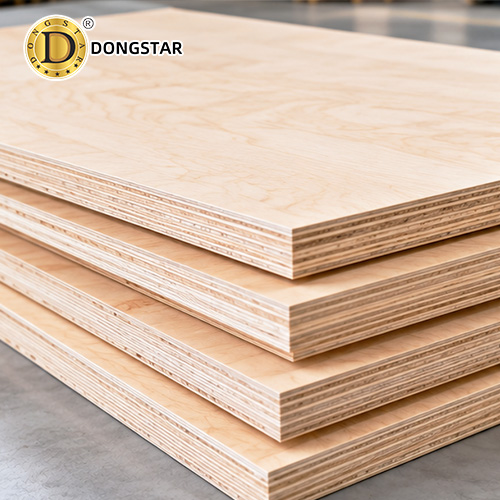
Custom Plywood Sizes vs Standard Plywood Sizes
The choice between standard and custom plywood should be based on the complete purchasing cost.
| Factor | Standard Plywood | Custom Plywood |
|---|---|---|
| Availability | Usually easier | Depends on production schedule |
| Production setup | Existing | May require adjustment |
| MOQ | Often lower | May be higher |
| Lead time | Usually predictable | May require additional planning |
| Cutting waste | Depends on application | Can potentially be reduced |
| OEM flexibility | Limited | Higher |
| Packaging | Standard options | Can be customized |
| Best for | Regular wholesale demand | Projects and repeat OEM production |
For distributors, standard sizes are often convenient because customers already recognize them.
For manufacturers and large projects, however, custom plywood sizes can make more sense when they solve a measurable production or installation problem.
The key is to compare the total cost rather than assuming custom plywood is always more expensive.
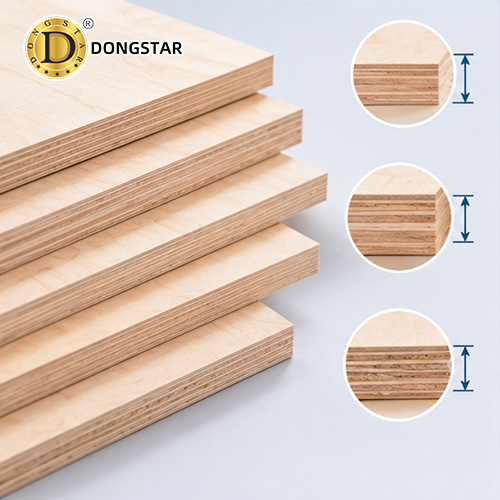
Can You Order Custom Plywood Thickness?
Yes, custom or less-common plywood thicknesses may be possible depending on the plywood construction and manufacturing process.
Dongstar’s current plywood product information lists thickness options from approximately 2.7mm to 40mm, depending on product configuration.
Common commercial requirements may include 6mm, 9mm, 12mm, 15mm and 18mm, while thicker plywood can be used for applications requiring greater stiffness or panel thickness.
But thickness should not be treated independently from plywood construction.
An RFQ for custom plywood thickness should also identify:
- Plywood type
- Number of veneer layers
- Core species
- Face/back veneer
- Glue type
- Target thickness
- Thickness tolerance
- Surface sanding
- Moisture requirement
- Applicable standard
For example, asking for “18mm plywood” does not fully define a product.
Two 18mm plywood panels can differ significantly in core construction, density, veneer quality, bonding system and intended application.
What Does “Plywood Sheets Cut to Size” Actually Mean?
“Plywood sheets cut to size” can describe two different B2B requirements.
1. Custom Manufacturing Size
The manufacturer produces plywood panels directly in a specified dimension.
This is useful for large-volume orders where the same custom dimension will be required repeatedly.
2. Finished Sheet Cutting
The supplier takes a standard plywood sheet and cuts it into smaller finished panels.
This may be suitable for buyers who need:
- Cabinet panels
- Furniture components
- Packaging panels
- CNC blanks
- Interior components
- Pre-cut construction panels
These two services should not be confused.
A custom manufacturing size changes the production specification.
Cut-to-size processing is a secondary cutting operation performed after the plywood panel has been manufactured.
For large recurring orders, buyers should ask the supplier which method is being proposed and compare the resulting material yield and cost.
What Custom Plywood Dimensions Can a Manufacturer Produce?
There is no single universal list of custom plywood dimensions.
Production capability depends on:
- Press size
- Veneer dimensions
- Lay-up process
- Trimming equipment
- Sanding equipment
- Product type
- Target thickness
- Production volume
Dongstar currently lists 1220×2440mm, 1250×2500mm and 1250×3000mm as plywood sheet sizes and also identifies customized sizes as an available option.
For a custom order, instead of asking:
“What custom sizes can you make?”
a better approach is:
“Can you manufacture 1350×2700×18mm plywood, tolerance ±0.5mm, with eucalyptus core, BB/CC face/back and WBP glue, for 10 containers?”
The second question gives the manufacturer enough information to evaluate actual production feasibility.
What Plywood Thickness Is Suitable for Custom Production?
The appropriate thickness depends on the application rather than simply the desired strength.
Typical commercial applications may use:
| Thickness | Typical B2B Applications |
|---|---|
| 3–6mm | Back panels, lightweight components, packaging |
| 9–12mm | Furniture components, partitions, interior applications |
| 15mm | Furniture, flooring and construction components |
| 18mm | Cabinets, furniture, flooring, construction |
| 21–25mm | Heavy-duty panels and specialized applications |
| 30–40mm | Thick industrial or specialized panel applications |
These are general purchasing references rather than universal engineering requirements.
For structural or load-bearing applications, thickness should be selected together with span, support spacing, load, plywood grade, fastening method and applicable local standards.
A custom plywood manufacturer should therefore receive the complete technical requirement instead of being asked to choose the thickness without project information.
When Does Custom Plywood Reduce Cutting Waste?
Cutting efficiency is one of the strongest reasons to consider custom plywood.
Imagine a production line that repeatedly cuts the same components from plywood sheets.
With a standard sheet, the cutting pattern may leave:
- Long unused strips
- Small unusable pieces
- Excessive edge trimming
- Additional joints
- Higher labor requirements
A custom panel can sometimes be designed around the cutting layout.
The important calculation is:
Usable material ÷ purchased material = material utilization rate
For large-volume manufacturing, even a small improvement in material utilization can become significant.
However, the calculation should include the additional cost of custom production, packaging, handling and transportation.
A custom plywood size is commercially attractive when the overall saving or production benefit exceeds those additional costs.
What Should You Send to a Custom Plywood Manufacturer?
A professional RFQ should contain enough information for the manufacturer to quote the same product you actually need.
Use the following structure:
| Specification | Example |
|---|---|
| Product | Commercial Plywood |
| Size | 1350×2700mm |
| Thickness | 18mm |
| Thickness Tolerance | ±0.5mm |
| Core | Eucalyptus |
| Face/Back | BB/CC |
| Glue | WBP |
| Surface | Double-sided sanded |
| Moisture | Required range |
| Quantity | 10 × 40HQ |
| Packaging | Export standard |
| Destination | European port |
| Certification | Required documents |
| Inspection | Third-party inspection if required |
For plywood sheets cut to size, also specify:
- Finished panel dimensions
- Cutting tolerance
- Cutting quantity
- Grain direction
- Edge requirements
- Cutting layout
- Packaging of finished pieces
This information can significantly reduce quotation errors.
What Is the MOQ for Custom Plywood?
Custom plywood normally requires more production planning than standard plywood.
The minimum order quantity can depend on:
- Custom dimensions
- Thickness
- Plywood type
- Veneer availability
- Production setup
- Packaging requirements
- Factory schedule
There is therefore no universal MOQ for all custom plywood products.
A small one-time custom order may not be commercially efficient, while a recurring OEM program with several containers per month can make customized production much more practical.
For this reason, B2B buyers should tell the manufacturer their expected annual or recurring purchase volume, not only the quantity required for the first shipment.
That information helps the supplier evaluate whether custom production is commercially feasible.
How to Control Quality for Custom Plywood Orders
Custom dimensions increase the importance of quality control because the buyer cannot rely only on the supplier’s standard product specification.
Before mass production, confirm:
- Exact length and width
- Thickness tolerance
- Squareness
- Flatness
- Core construction
- Face/back grade
- Glue specification
- Moisture requirement
- Surface finish
- Packaging
For large B2B orders, it is also useful to approve a physical sample before full production.
The sample should be measured and checked against the agreed specification.
The approved specification should then become part of the purchase order or sales contract.
This creates a clear reference for repeat production and pre-shipment inspection.
How Custom Plywood Affects Shipping and Container Loading
Custom dimensions can improve production efficiency, but they can also change logistics.
A different sheet dimension may affect:
- Sheets per pallet
- Pallet footprint
- Stack height
- Container utilization
- Warehouse storage
- Forklift handling
- Total shipment weight
This is particularly important when the custom panel is significantly larger than a standard plywood sheet.
Before confirming a large custom order, ask the supplier for:
- Packing method
- Sheets per pallet
- Pallet dimensions
- Number of pallets per container
- Gross weight
- Net weight
- Estimated container loading
The best custom plywood specification is not necessarily the one that produces the largest panel.
It is the one that balances production efficiency, material utilization and logistics cost.
How to Choose a Custom Plywood Manufacturer
For a large project or recurring OEM program, the supplier’s manufacturing capability matters more than the ability to produce one experimental sample.
When comparing a custom plywood manufacturer, ask:
Can the factory produce the required dimensions?
Confirm that the requested length, width and thickness are technically feasible for the product.
Can it maintain the required tolerance?
A custom dimension without a clearly defined tolerance is incomplete.
Can it repeat the specification?
Repeatability is critical for wholesalers, furniture manufacturers and long-term projects.
Can it provide the required core and surface?
Custom size is only one part of the specification.
Can it support export logistics?
Packaging and container loading should be considered before the quotation is finalized.
Can it provide samples and inspection support?
A professional B2B supplier should be able to establish a clear sample-to-production process.
Dongstar’s official plywood range covers commercial, furniture, hardwood, construction and waterproof plywood, with standard and customized sizes listed as part of its product specifications.
Custom Plywood for Furniture, Construction and OEM Projects
Custom plywood is particularly relevant to businesses that use large volumes of panels rather than simply reselling standard sheets.
Furniture Manufacturing
Custom dimensions can be designed around cabinet sides, shelves, doors and other repeat components.
CNC Production
A suitable panel size can improve nesting efficiency and reduce unnecessary trimming.
Construction
Larger or project-specific plywood panels may help reduce joints and simplify installation, depending on the application.
Formwork
Project-specific dimensions can be considered alongside thickness, film, core construction and required reuse performance.
Industrial Components
OEM manufacturers may require consistent plywood dimensions that are different from common market sizes.
In each case, the custom specification should begin with the finished application and work backward to the plywood requirement.
Frequently Asked Questions About Custom Plywood
Can I order plywood in a custom size?
Yes. Custom plywood sizes can be produced or supplied by manufacturers depending on the product, equipment, order volume and required tolerance.
Can plywood be ordered in a custom thickness?
Custom or less-common thickness specifications may be possible. Availability depends on the plywood construction and manufacturing process.
Can a supplier cut plywood sheets to size?
Yes. Some suppliers can provide cut-to-size plywood as a secondary processing service. Confirm cutting tolerance, grain direction, quantity and finished dimensions.
Is custom plywood more expensive than standard plywood?
Not necessarily on a total-cost basis. Custom production may have additional setup or MOQ requirements, but it can reduce cutting waste and production costs in high-volume applications.
What is the minimum order for custom plywood?
There is no universal MOQ. It depends on the custom specification, product type, production requirements and factory schedule. Ask the manufacturer for an MOQ based on your exact specification.
Can custom plywood be produced for OEM projects?
Yes. Custom plywood is commonly considered for OEM and repeat-production programs where dimensions, thickness, surface, core and other specifications need to remain consistent.
How long does custom plywood production take?
Lead time depends on the specification, quantity, production schedule, raw-material availability and packaging requirements. Confirm the production schedule with the manufacturer before placing an order.
What information should I provide for a custom plywood quotation?
Provide the exact dimensions, thickness, tolerance, plywood type, core, face/back grade, glue, surface treatment, quantity, packaging, destination and required certifications.
Final Checklist Before Ordering Custom Plywood
Before placing a bulk order, make sure your RFQ answers these questions:
Dimensions
- What exact length and width are required?
- What dimensional tolerance is acceptable?
- Is the panel manufactured to size or cut after production?
Thickness
- What nominal thickness is required?
- What thickness tolerance is acceptable?
- Is the thickness suitable for the application?
Construction
- What core material is required?
- What face/back grade is required?
- What glue system is required?
Processing
- Is sanding required?
- Is edge trimming required?
- Are plywood sheets cut to size?
- Is CNC cutting required?
Quality
- Has a physical sample been approved?
- What inspection method will be used?
- What documents or certifications are required?
Logistics
- How many sheets per pallet?
- How many pallets per container?
- What is the expected loading volume?
- How will the custom panels be protected during transportation?
Commercial
- What is the MOQ?
- What is the production lead time?
- What is the price per sheet or per cubic meter?
- What is the total landed cost?
Custom plywood is most valuable when it solves a real purchasing or manufacturing problem.
For global project buyers, wholesalers, importers and OEM manufacturers, the goal should not simply be to find a factory willing to make a different plywood size.
The goal is to find a custom plywood manufacturer that can repeatedly produce the required size, thickness and construction at a commercially viable volume.
That is the difference between a one-time custom order and a reliable long-term supply program.
For your next bulk plywood project, start with the complete specification. Then ask the manufacturer whether a standard panel or a custom panel gives you the better overall result.
Recommended Reading from Dongstar Blog
- What is Plywood? Complete Guide for Importers in 2026
- Plywood Sheets Wholesale Sizes: Standard & Custom Guide
- How Thick Is 3/4 Inch Plywood in mm? 1/2″ & 5/8″ Guide
- 1220×2440mm vs 1250×2500mm Plywood: Size Guide for Buyers
- 12mm vs 18mm Plywood: Which Thickness Should You Choose?
- Standard Plywood Sheet Sizes: 4×8, 1220×2440mm & More | 2026 Guide
- Plywood Sizes & Thickness: Standard Sheet Dimensions Guide 2026
- OSB vs Particle Board: 2026 Comparison for Global Buyers | China Supplier Guide
- 7/16 OSB Board Weight and 7/16 OSB Price Guide 2026 | OSB Supplier China
Post time: Sep-16-2026