


Table of Contents
- 12mm vs 18mm Plywood: The Quick Answer
- What Is the Difference Between 12mm and 18mm Plywood?
- 12mm vs 18mm Plywood Thickness Comparison
- Where Is 12mm Plywood Commonly Used?
- Where Is 18mm Plywood Commonly Used?
- 12mm vs 18mm Plywood for Furniture and Cabinets
- 12mm vs 18mm Plywood for Construction
- Does 18mm Plywood Cost More Than 12mm?
- Weight and Handling: 12mm vs 18mm Plywood
- How Plywood Core and Glue Affect Performance
- How to Choose the Right Plywood Thickness for Bulk Orders
- Wholesale Plywood Sheets 12mm vs 18mm
- What to Ask a Plywood Supplier Before Ordering
- Why Source 12mm and 18mm Plywood from China?
- Why Consider Dongstar for Wholesale Plywood?
- Frequently Asked Questions
- Final Buying Guide
What Is the Difference Between 12mm and 18mm Plywood?
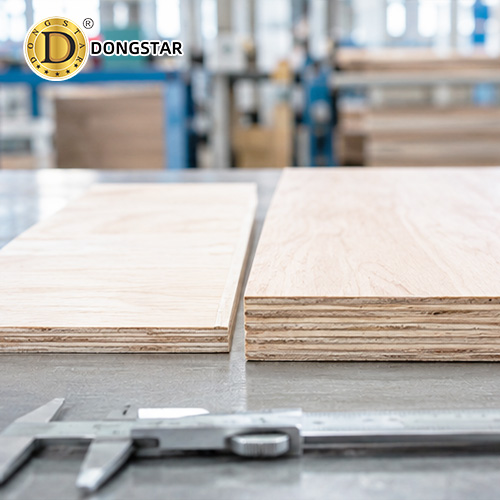
The most obvious difference is thickness: 18mm plywood is 6mm thicker than 12mm plywood.
That represents a 50% increase in nominal thickness.
This difference can have a meaningful effect on panel stiffness, weight and material consumption.
However, it doesn’t mean that 18mm plywood is automatically 50% stronger in every direction or application. Plywood is a layered engineered wood product, and its performance depends on factors such as veneer species, veneer thickness, grain direction, number of plies, core quality and adhesive bonding.
For example, an importer buying 12mm plywood for cabinet backs may have no practical reason to upgrade to 18mm.
On the other hand, a project requiring panels to span between supports may benefit from the additional thickness and stiffness of 18mm material.
This is why the correct purchasing question isn’t:
“Which thickness is better?”
It is:
“Which thickness meets the performance requirement at the lowest practical total cost?”
That distinction is especially important for commercial buyers.

12mm vs 18mm Plywood Thickness Comparison
A useful way to compare the two thicknesses is to consider the complete supply chain.
12mm plywood
12mm plywood is often selected when the buyer wants a balance between panel strength and manageable weight.
Typical advantages include:
- Lower material consumption
- Easier manual handling
- Lower weight per sheet
- Convenient cutting and installation
- Potentially lower purchase cost
- Good suitability for many furniture applications
18mm plywood
18mm plywood is generally selected when the panel needs more stiffness or a heavier-duty construction.
Typical advantages include:
- Greater panel thickness
- Better stiffness in many applications
- More substantial screw-fixing material
- Better suitability for heavier furniture components
- Common use in flooring and construction applications
For bulk buyers, however, there’s another consideration: price per cubic meter versus price per sheet.
An 18mm sheet contains substantially more wood material than a 12mm sheet of the same length and width.
Therefore, comparing only the price per sheet can be misleading.
A professional buyer should compare:
Price per sheet → price per m² → price per m³ → delivered cost → application performance.
Where Is 12mm Plywood Commonly Used?
12mm plywood occupies a useful middle ground.
It’s thick enough for many furniture and interior applications without becoming unnecessarily heavy.
Common uses include:
- Cabinet components
- Furniture panels
- Partitions
- Wall panels
- Shelving with appropriate support
- Doors and panels
- Packaging
- Interior construction
- Decorative applications
- Lightweight structural components where permitted
For furniture manufacturers, 12mm can be particularly attractive when the product design doesn’t require a heavy panel.
It also makes sense where workers need to move large numbers of panels throughout a production facility.
For example, a factory producing hundreds of cabinets per day may prefer 12mm material for certain components simply because it reduces handling weight and material consumption.
That doesn’t mean 12mm is suitable for every cabinet component.
A shelf carrying heavy loads over a long span may need thicker material, additional support, a different plywood grade or a different construction method.
The application should determine the specification.
Where Is 18mm Plywood Commonly Used?
18mm plywood is one of the most widely specified thicknesses for heavier-duty panel applications.
Typical uses include:
- Furniture carcasses
- Heavy-duty shelves
- Tables and worktops
- Flooring systems
- Construction panels
- Structural applications where the specified plywood grade permits
- Cabinet sides and bases
- Doors
- Heavy-duty packaging
- Industrial applications
For construction projects, 18mm is often considered when the panel needs to withstand greater loads or when greater stiffness is useful.
However, the correct specification depends on the relevant building system and local standards.
An importer should never assume that “18mm plywood” automatically qualifies as structural plywood.
Structural performance depends on the complete product specification and applicable standard.
12mm vs 18mm Plywood for Furniture and Cabinets
Furniture is one area where the decision can go either way.
For cabinet backs, drawer components, partitions and certain internal panels, 12mm plywood can be a practical choice.
For cabinet sides, bases, heavy shelves and furniture that must withstand repeated use, 18mm plywood may provide a more substantial panel.
But furniture designers should also consider edge treatment.
If the panel will receive screws, hinges, connectors or other hardware, the edge construction matters.
A buyer should discuss:
- Number of veneer plies
- Core density
- Screw holding
- Edge quality
- Surface sanding
- Thickness tolerance
- Moisture resistance
- Face and back grade
For CNC furniture production, dimensional consistency becomes especially important.
A factory might prefer 12mm plywood because its cutting programs are designed around that thickness. Another manufacturer might standardize on 18mm because it simplifies its furniture construction.
In other words, the best plywood thickness is often the thickness that fits your production system.
12mm vs 18mm Plywood for Construction
Construction applications require more caution.
The question isn’t simply whether 12mm or 18mm plywood is stronger.
The correct thickness depends on:
- Span
- Load
- Support spacing
- Fastener system
- Moisture exposure
- Panel grade
- Building code
- Engineering requirements
For some wall or interior applications, 12mm may be adequate.
For flooring, heavy-duty panels or applications with wider support spacing, 18mm may be more appropriate.
For structural work, always match the plywood to the project specification and local regulations.
This is an important E-E-A-T point for B2B content: thickness alone is not a structural certification.
If the project specification calls for a particular plywood standard, grade or certified structural panel, that requirement takes priority over a simple thickness comparison.
Does 18mm Plywood Cost More Than 12mm?
Usually, yes, if the sheet length and width, plywood type and quality are otherwise comparable.
The reason is straightforward: an 18mm panel contains more wood material than a 12mm panel.
For buyers comparing wholesale quotations, however, the sheet price shouldn’t be the only metric.
Suppose Supplier A offers a cheap 12mm sheet, while Supplier B offers 18mm at a higher price.
That doesn’t mean Supplier A is cheaper for your project.
The 12mm material might require:
- Additional framing
- More supports
- Reinforcement
- Different hardware
- More pieces
- Higher installation labor
The 18mm panel could potentially reduce some of those requirements.
Conversely, if your application doesn’t need 18mm, paying for the additional material simply increases cost.
For wholesale plywood sheets 12mm and wholesale plywood sheets 18mm, request pricing in several formats:
- Price per sheet
- Price per square meter
- Price per cubic meter
- FOB or CIF price
- Total container value
This makes supplier comparisons much more transparent.
Weight and Handling: 12mm vs 18mm Plywood
Weight matters more than many buyers expect.
For plywood sheets with the same length and width and similar density, 18mm plywood contains approximately 50% more thickness than 12mm plywood.
Therefore, its weight per square meter will generally be significantly higher.
Actual weight depends on:
- Wood species
- Core density
- Moisture content
- Glue content
- Panel construction
- Surface treatment
This matters during:
- Factory handling
- Furniture assembly
- Installation
- Palletizing
- Forklift operation
- Container loading
For manual installation, lighter 12mm panels can be easier for workers to move.
For a factory importing a full container, the difference also affects logistics planning.
Ask your supplier for actual or estimated:
- Net weight per sheet
- Gross weight per pallet
- Number of sheets per pallet
- Pallet weight
- Container gross weight
Don’t rely on thickness alone to calculate shipping weight.
How Plywood Core and Glue Affect Performance
This is where a basic thickness comparison becomes a real purchasing guide.
Plywood is not simply “wood cut into sheets.”
Its performance depends heavily on construction.
Two 18mm plywood panels may have different performance because one uses a high-quality hardwood core while another uses a lower-density core with more defects.
Important specifications include:
Core
Ask whether the core is:
- Poplar
- Eucalyptus
- Birch
- Hardwood
- Mixed hardwood
- Other species
Veneer construction
Ask about:
- Number of plies
- Veneer thickness
- Core gaps
- Overlaps
- Repairs
Adhesive
Depending on the application, buyers may require:
- MR glue
- WBP glue
- Phenolic systems
- Other specified adhesive systems
Surface
Check:
- Face grade
- Back grade
- Sanding
- Thickness calibration
- Surface defects
This is why an experienced China plywood supplier should quote a complete specification rather than simply “12mm plywood” or “18mm plywood.”
How to Choose the Right Plywood Thickness for Bulk Orders
For project buyers and importers, use a simple decision process.
Step 1: Identify the application
Furniture? Flooring? Construction? Packaging? Cabinets?
Step 2: Establish the engineering requirement
Determine the required load, span and support conditions.
Step 3: Select the thickness
Compare 12mm and 18mm against the actual requirement.
Step 4: Compare plywood construction
Don’t compare thickness while ignoring core and glue.
Step 5: Calculate material utilization
Look at sheet yield and cutting waste.
Step 6: Calculate logistics
Compare sheet weight, pallet quantities and container utilization.
Step 7: Request samples
A sample should be evaluated before a large production order.
Step 8: Confirm the final specification
The approved sample and written specification should become the reference for bulk production.
This process helps avoid a common purchasing mistake: selecting plywood based on the cheapest initial quotation.
Wholesale Plywood Sheets 12mm vs 18mm
When sourcing wholesale plywood sheets 12mm or wholesale plywood sheets 18mm, buyers should ask suppliers to quote both options under exactly the same conditions.
For example:
1220×2440×12mm commercial plywood
Same face/back grade
Same core
Same glue
Same packaging
Same quantity
Same Incoterm
Then request:
1220×2440×18mm commercial plywood
Same specifications
This creates a fair comparison.
For larger projects, consider asking the factory for a quotation based on:
- 1 container
- 5 containers
- 10 containers
- Annual contract volume
Volume can change the commercial structure significantly.
Also ask whether the quoted price includes:
- Export packaging
- Palletizing
- Loading
- Documentation
- Inspection
- Certification
A low factory price isn’t necessarily a low landed cost.
What to Ask a Plywood Supplier Before Ordering
Before approving a supplier, ask for clear answers to these questions:
- What is the actual finished thickness?
- What is the thickness tolerance?
- What are the actual sheet dimensions?
- What core species are used?
- How many plies does the panel have?
- What adhesive is used?
- What face and back grades are available?
- Is the plywood sanded or calibrated?
- What quality standard applies?
- Can you provide production samples?
- What is the MOQ?
- How many sheets fit in a container?
- What is the estimated gross weight?
- Can you provide third-party inspection?
- What is the production lead time?
These questions are especially important when comparing multiple suppliers.
A reliable factory should be able to provide consistent technical answers rather than changing specifications after the order is placed.
Why Source 12mm and 18mm Plywood from China?
China remains an important sourcing market for plywood and other wood-based panels because international buyers can find manufacturers offering a broad range of specifications and production volumes.
For project buyers and wholesalers, sourcing directly from a factory can provide opportunities to discuss:
- 12mm and 18mm production
- 1220×2440 mm sheets
- 1250×2500 mm sheets
- Different core materials
- Different glue systems
- Surface grades
- Export packaging
- OEM requirements
- Container-scale orders
However, the key is supplier verification.
A buyer should evaluate manufacturing capability, quality consistency, communication, samples, inspection procedures and export experience.
The cheapest quotation is rarely enough information to make a safe purchasing decision.
Why Consider Dongstar for Wholesale Plywood?
Dongstar’s official website covers plywood and other wood panel products for international buyers, including commercial plywood and film faced plywood.
Its commercial plywood product information includes multiple thickness options and standard sheet formats such as 1220×2440 mm and 1250×2500 mm, with customized specifications available depending on requirements.
For a buyer comparing 12mm and 18mm plywood, the better approach is to send Dongstar a complete RFQ rather than asking only for a unit price.
Include:
- Plywood type
- 12mm or 18mm thickness
- Sheet size
- Face/back grade
- Core material
- Glue requirement
- Quantity
- Packaging
- Destination port
- Required certifications
This allows the factory to quote against a clear specification and helps both sides avoid misunderstandings.
For bulk plywood sourcing, request samples and a detailed quotation before approving mass production.
View Dongstar China Plywood
Frequently Asked Questions
Is 18mm plywood stronger than 12mm plywood?
Generally, 18mm plywood provides greater thickness and stiffness than comparable 12mm plywood. However, actual strength depends on plywood construction, wood species, number of plies, adhesive system and applicable grade or standard.
Is 12mm plywood good for cabinets?
Yes. 12mm plywood can be suitable for many cabinet components, particularly where the design doesn’t require a heavy-duty panel. The correct thickness depends on the cabinet design, span, load and hardware.
Is 18mm plywood better for furniture?
Not necessarily. 18mm is useful for heavier furniture components, shelves and carcasses, but 12mm may be more economical for lighter components. The best choice depends on the furniture design.
Is 12mm plywood cheaper than 18mm?
Normally, yes, when the plywood type, size, quality and other specifications are comparable. However, buyers should compare total project cost rather than only price per sheet.
What is the difference between 12mm and 18mm plywood?
The nominal thickness differs by 6mm. 18mm is 50% thicker than 12mm, which generally means greater panel stiffness and material weight. Performance still depends on the complete plywood construction.
Should I buy 12mm or 18mm plywood for flooring?
It depends on the flooring system, support spacing, expected loads and applicable building requirements. 18mm is often considered for heavier-duty flooring applications, but the project specification should determine the final choice.
Which is easier to handle, 12mm or 18mm plywood?
12mm plywood is generally lighter and easier to move manually. 18mm plywood is heavier but may provide advantages where greater stiffness is required.
Can I buy 12mm and 18mm plywood wholesale from China?
Yes. Chinese plywood manufacturers can supply both thicknesses, subject to product type, factory capability, MOQ and specification.
Final Buying Guide: 12mm or 18mm?
There is no universal winner.
Choose 12mm plywood when your project prioritizes:
- Lower weight
- Easier handling
- Lower material consumption
- Furniture and interior applications
- Adequate performance without unnecessary thickness
Choose 18mm plywood when your project prioritizes:
- Greater panel stiffness
- Heavier-duty furniture
- Flooring or construction applications where specified
- More substantial screw-fixing material
- Reduced deflection in suitable applications
For B2B buyers, the smartest approach is to compare the two thicknesses based on the complete product specification and total project cost.
Don’t compare a cheap 12mm panel with a premium 18mm panel and call the difference a “thickness premium.” Compare like for like.
And don’t select 18mm simply because thicker sounds better.
The right plywood is the one that meets the technical requirement, survives the intended working conditions, fits your production process and delivers the best overall value.
For a wholesale order, send the supplier your exact size, thickness, core, glue, face grade, quantity and destination. That gives the factory enough information to recommend the right specification and prepare a meaningful quotation.
Recommended Reading from Dongstar Blog
- What is Plywood? Complete Guide for Importers in 2026
- Standard Plywood Sheet Sizes: 4×8, 1220×2440mm & More | 2026 Guide
- Plywood Sizes & Thickness: Standard Sheet Dimensions Guide 2026
- OSB vs Particle Board: 2026 Comparison for Global Buyers | China Supplier Guide
- 7/16 OSB Board Weight and 7/16 OSB Price Guide 2026 | OSB Supplier China
- How Much Does a 4×8 Sheet of 1/2 Plywood Weigh? | 1/2 Plywood Weight Guide 2026
- Plywood Price per Sheet in 2026 | China Plywood Price Guide for Global Buyers
- How to Negotiate Plywood Prices with Chinese Factories: 12 Proven Strategies to Reduce Costs Without Sacrificing Quality
Post time: Aug-21-2026