
Table of Contents
- What Are the Different Types of Plywood?
- 1. Commercial Plywood
- 2. Furniture Plywood
- 3. Birch Plywood
- 4. Hardwood Plywood
- 5. Film Faced Plywood
- 6. Waterproof Plywood
- 7. Marine Plywood
- 8. Structural Plywood
- 9. Decorative Plywood
- Plywood Types Compared: Which Should You Choose?
- How to Choose the Right Plywood for Bulk Orders
- Plywood Types Available from Dongstar
- Frequently Asked Questions About Plywood Types
What Are the Different Types of Plywood?
The different types of plywood can be classified by their intended use, wood species, surface treatment, bonding performance and structural requirements.
For commercial purchasing, nine useful categories are commercial, furniture, birch, hardwood, film faced, waterproof, marine, structural and decorative plywood.
These categories are not always mutually exclusive. For example, birch plywood can also be furniture plywood, while film faced plywood may use a hardwood core. A product’s name alone does not establish its complete technical performance.
Before comparing suppliers, buyers should identify the required application and then confirm the face veneer, core material, glue system, grade, dimensions and relevant standards.
1. Commercial Plywood
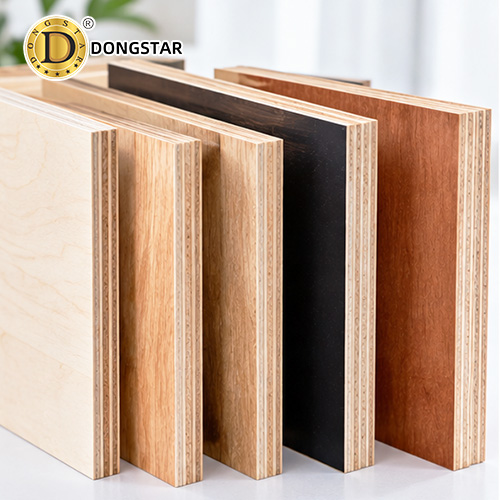
Commercial plywood is a general-purpose wood panel used in furniture components, interior applications, packaging and various building projects.
Its construction can vary by manufacturer, market and specification. Buyers should therefore confirm the actual veneer species, core composition and bonding requirements rather than assuming all commercial plywood has the same properties.
Typical applications
- Furniture components and cabinets
- Interior panels and fixtures
- General-purpose woodworking
- Boxes and industrial packaging
What buyers should check
Face and back grade, core material, thickness tolerance, glue type and surface finish are the main points to confirm.
Commercial plywood can be a practical choice for high-volume orders where a clear specification and consistent quality matter more than a premium decorative face.
2. Furniture Plywood
Furniture plywood is selected for manufacturing cabinets, wardrobes, shelving, tables and other furniture components. Depending on the design, it may be used as a visible panel or as an internal structural component.
The right product depends on the finishing process. Panels intended for painting or lamination may need a smooth, consistent surface, while components hidden inside furniture may have different appearance requirements.
Typical applications
- Cabinets and wardrobes
- Tables and shelving
- Furniture frames and components
- Commercial fixtures and display units
What buyers should check
Confirm the face quality, core consistency, machining performance, thickness tolerance and compatibility with the intended finish. For interior furniture, specify the required formaldehyde-emission classification or other applicable market requirements.
For furniture manufacturers, consistency across repeat orders is particularly important because differences in thickness or surface quality can affect production efficiency.
3. Birch Plywood
Birch plywood uses birch veneer on the face, back, core or a combination of layers, depending on the product specification. It is widely considered for applications requiring a relatively uniform appearance and consistent multi-layer construction.
Its actual strength, density and finish depend on the grade, construction and manufacturing quality.
Typical applications
- Furniture and cabinet components
- CNC-cut parts
- Interior fixtures
- Shelving and industrial components
What buyers should check
Specify whether birch is required on the face and back only or throughout the core. Also confirm veneer grade, number of layers, thickness tolerance, bonding requirements and surface quality.
Birch plywood can cost more than some mixed-core alternatives. For bulk purchasing, buyers should compare the complete construction rather than comparing product names alone.
4. Hardwood Plywood
Hardwood plywood is made with hardwood veneers in some or all layers. The species and layer construction vary, so the term does not guarantee a particular density, strength or surface appearance.
Depending on the specification, hardwood plywood can be used in furniture, construction, cabinetry and industrial applications.
Typical applications
- Furniture production
- Cabinetry and interior components
- General construction
- Industrial panels
What buyers should check
Ask the supplier to identify the face and back species, core species, grade and adhesive system. “Hardwood core” alone may cover different combinations of wood species and construction quality.
When strength or weight is important, request the relevant technical data instead of assuming every hardwood plywood panel performs identically.
5. Film Faced Plywood
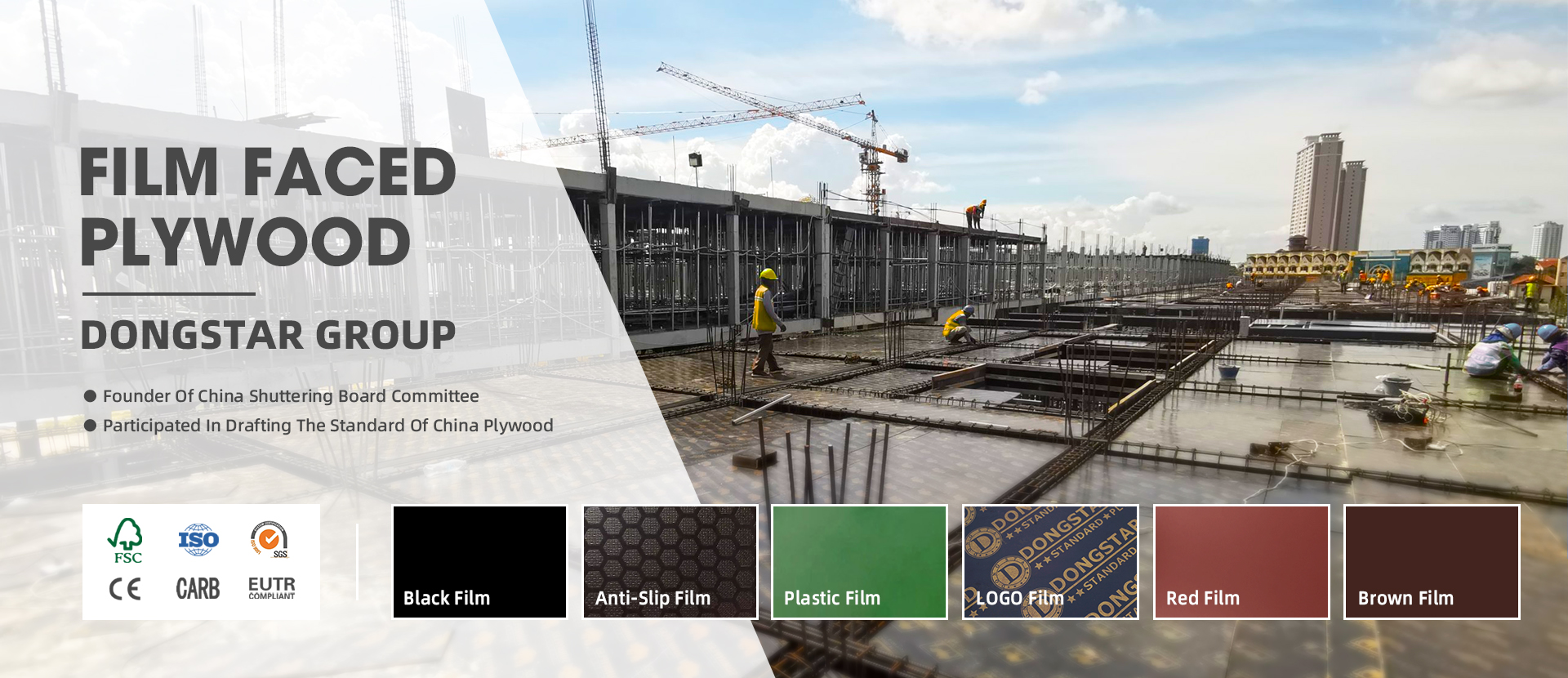
Film faced plywood has a resin-impregnated film bonded to its surface. It is widely used in concrete formwork because the coated surface can help produce a smoother concrete finish and protect the panel during use.
Its service life depends on the panel construction, film quality, bonding performance, edge sealing, concrete conditions and handling practices.
Typical applications
- Concrete formwork
- Building and infrastructure projects
- Reusable shuttering systems
- Commercial construction
What buyers should check
Confirm the thickness, core construction, film type, glue system, edge sealing and expected reuse conditions. Buyers should also check whether the product meets the project’s requirements for concrete finish and panel dimensions.
Film faced plywood is not simply ordinary plywood with a dark surface. Its construction and performance need to match the intended formwork system.
6. Waterproof Plywood
Waterproof plywood is a common commercial term for plywood designed to provide a specified level of resistance to moisture or water exposure. However, the term alone does not define the exact performance of a panel.
The adhesive system, veneer construction, edge treatment and applicable testing standard all matter. Even a water-resistant panel can be damaged by prolonged exposure or unsuitable installation conditions.
Typical applications
- Construction applications exposed to moisture
- Selected exterior uses
- Panels requiring water-resistant bonding
- Projects with defined moisture-resistance requirements
What buyers should check
Ask for the exact glue specification, applicable test standard, intended exposure conditions and any relevant product documentation. Confirm whether the requirement concerns moisture-resistant bonding, water exposure or a specific structural application.
Do not assume that “waterproof” means suitable for every exterior or marine environment.
7. Marine Plywood
Marine plywood is intended for applications where high-quality construction and reliable bonding are required under demanding moisture conditions. The exact requirements depend on the relevant product standard and intended use.
The name should not be interpreted as meaning that every panel is suitable for permanent immersion or that the finished structure needs no protective coating.
Typical applications
- Boatbuilding components
- Marine-related interior fit-outs
- Moisture-exposed construction
- Specialized transport and industrial projects
What buyers should check
Confirm compliance with the applicable marine plywood standard, veneer quality, core construction, bonding performance and permitted defects. For regulated or safety-critical applications, verify the technical documentation and suitability for the intended use.
Marine plywood should be specified by standard and performance requirements, not by name alone.
8. Structural Plywood
Structural plywood is designed for applications where the panel must meet defined structural performance requirements. It should be selected according to the relevant grading system, standard and design specification.
Not every commercial plywood sheet is suitable for load-bearing construction, even if it appears thick or strong.
Typical applications
- Structural sheathing
- Floors and roofs in approved building systems
- Wall construction
- Engineered building components
What buyers should check
Confirm the structural grade, design values where required, span and load conditions, exposure classification, thickness and compliance documentation.
For projects subject to building codes, the engineer or project specification should determine the acceptable product. A generic plywood description is not a substitute for structural verification.
9. Decorative Plywood
Decorative plywood is selected for its visible surface, which may feature natural wood veneer or an applied decorative finish. It is commonly used where the panel contributes to the appearance of a finished interior or product.
Surface options and performance vary by manufacturer and product type.
Typical applications
- Decorative wall panels
- Furniture and cabinetry
- Retail displays and commercial interiors
- Interior fixtures and architectural components
What buyers should check
Specify the face material, grain appearance, color consistency, surface finish, back grade and compatibility with painting, laminating or other finishing processes.
For large projects, approve a physical sample before mass production. This helps reduce the risk of unacceptable variation between the approved appearance and delivered panels.
Plywood Types Compared: Which Should You Choose?
The table below summarizes typical uses. The final selection should always be based on the product’s actual specification.
| Plywood Type | Common Applications | Main Purchasing Consideration |
|---|---|---|
| Commercial plywood | General furniture, interiors, packaging | Core, grade and price |
| Furniture plywood | Cabinets, tables, fixtures | Surface and machining quality |
| Birch plywood | CNC parts, furniture, shelving | Birch construction and consistency |
| Hardwood plywood | Furniture, construction, industry | Species and core specification |
| Film faced plywood | Concrete formwork | Film, bonding and reuse conditions |
| Waterproof plywood | Moisture-exposed applications | Glue system and test standard |
| Marine plywood | Marine-related and demanding moisture applications | Applicable standard and bonding |
| Structural plywood | Load-bearing building systems | Structural grade and compliance |
| Decorative plywood | Visible interior surfaces and furniture | Face appearance and finish |
Remember that these labels can overlap. A plywood panel may be both hardwood plywood and structural plywood, for example, if its materials and tested performance meet the relevant requirements.
How to Choose the Right Plywood for Bulk Orders
For importers, wholesalers, project buyers and manufacturers, choosing plywood begins with the application—not the lowest quotation.
Use the following checklist before sending an RFQ.
1. Define the end use.
State whether the plywood is intended for furniture, concrete formwork, construction, decorative interiors, packaging or another application.
2. Specify the face and back.
Identify the veneer species, grade and surface treatment. If appearance is important, provide an approved sample or reference.
3. Confirm the core.
State the required species or construction, especially when weight, machining or structural performance matters.
4. Specify glue and exposure conditions.
Describe the required bonding performance and intended environment. Reference the relevant standard where applicable.
5. Confirm dimensions and tolerances.
Provide the required length, width, thickness and acceptable tolerances. Standard sizes and custom sizes may be available depending on the product.
6. Check compliance requirements.
Identify the destination market and any applicable emissions, structural, environmental or product-certification requirements.
7. Approve samples and inspection criteria.
For large orders, agree on the product specification and inspection method before mass production.
8. Compare complete quotations.
Check whether all suppliers are quoting the same materials, dimensions, grade, glue system, packaging and quantity. Include freight and other relevant costs when comparing delivered prices.
A clear specification helps reduce misunderstandings and makes it easier to assess whether a manufacturer can maintain consistent quality across repeat orders.
Plywood Types Available from Dongstar
Dongstar supplies plywood for global B2B buyers, including commercial, furniture, hardwood, construction and waterproof plywood. Its product range lists common sizes such as 1220 × 2440 mm, 1250 × 2500 mm and 1250 × 3000 mm, alongside custom dimensions depending on the product. Listed thickness options range from approximately 2.7 to 40 mm.
Face and back options, core materials, grades and glue systems vary by specification. Buyers should confirm the exact configuration for the intended application rather than assuming every option is available in every combination.
For a quotation, provide the plywood type, dimensions, thickness, face/back grade, core, glue, quantity, destination and applicable compliance requirements. This allows the supplier to recommend a suitable configuration and prepare a more comparable offer.
Frequently Asked Questions About Plywood Types
What are the main types of plywood?
Common types include commercial, furniture, birch, hardwood, film faced, waterproof, marine, structural and decorative plywood. The categories can overlap because they describe different materials, applications or performance requirements.
Which type of plywood is best for furniture?
Furniture plywood is a common starting point, while birch or decorative plywood may be suitable for specific appearance or machining requirements. The correct choice depends on the furniture design, finishing process, load requirements and budget.
Which plywood is used for concrete formwork?
Film faced plywood is widely used for concrete formwork. Buyers should confirm the panel thickness, core, film, bonding system, edge sealing and expected reuse conditions.
Is waterproof plywood the same as marine plywood?
No. The terms do not automatically indicate the same specification or compliance level. Marine plywood may need to meet a particular standard, while waterproof plywood is often used as a broader commercial description. Always check the actual product requirements.
Is hardwood plywood always stronger than softwood plywood?
Not necessarily. Performance depends on the wood species, panel construction, grade, adhesive and testing standard. The term “hardwood” alone is not sufficient to establish structural performance.
Can one plywood type be used for several applications?
Yes, if the product specification meets the requirements of each application. However, a panel suitable for furniture may not be suitable for structural construction or concrete formwork without the required technical performance.
What information should I provide when buying plywood wholesale?
Provide the intended use, size, thickness, face/back grade, core material, glue system, surface finish, quantity, destination market, compliance requirements and packaging needs. For large orders, sample approval is recommended.
Final Takeaway
The different types of plywood serve different purposes. Commercial and furniture plywood are widely used in manufacturing and interiors, film faced plywood is common in concrete formwork, and structural or marine plywood must be selected according to their applicable performance requirements.
For B2B buyers, the most reliable approach is to define the application first, confirm the full product specification, and compare suppliers on equivalent terms.
Before placing a bulk plywood order, compare the construction and performance requirements—not just the product name or price per sheet.
Recommended Reading from Dongstar Blog
- What Is Plywood? Types, Uses & Buying Guide | Dongstar
- Can You Order Custom Plywood Sizes and Thicknesses? A B2B Manufacturer Guide
- How Is Plywood Made? From Wood Veneer to Finished Plywood Sheet
- What Is Plywood Made Of? Plywood Layers, Veneers & Core Explained
- Plywood Sheets Wholesale Sizes: Standard & Custom Guide
- How Thick Is 3/4 Inch Plywood in mm? 1/2″ & 5/8″ Guide
- 1220×2440mm vs 1250×2500mm Plywood: Size Guide for Buyers
- 12mm vs 18mm Plywood: Which Thickness Should You Choose?
Post time: Oct-13-2026