


Table of Contents
- What Is the Plywood Manufacturing Process?
- Step 1: How Are Logs Selected for Plywood?
- Step 2: How Are Plywood Veneers Produced?
- Step 3: How Are Veneers Dried and Graded?
- Step 4: How Are Plywood Layers Arranged?
- Step 5: How Is Glue Applied to Plywood Veneers?
- Step 6: How Is Plywood Hot Pressed?
- Step 7: How Is Plywood Trimmed and Sanded?
- Step 8: How Is Plywood Quality Checked?
- How Does the Manufacturing Process Affect Plywood Quality?
- How Should Buyers Choose a Plywood Manufacturer?
- Plywood Manufacturing FAQs
What Is the Plywood Manufacturing Process?
Plywood is manufactured by bonding multiple thin wood veneers together to form a stable engineered wood panel.
A typical production process includes:
- Log selection
- Log preparation
- Veneer production
- Veneer drying
- Veneer grading
- Layer assembly
- Glue application
- Pre-pressing or lay-up preparation
- Hot pressing
- Trimming
- Sanding or calibration
- Quality inspection
- Packaging and loading
The exact process varies according to the plywood type, wood species, thickness, surface treatment and required performance.
Commercial plywood, furniture plywood, structural plywood and film faced plywood may use different materials and production specifications even though the basic manufacturing principle is similar.
The important point for B2B buyers is that plywood quality is created throughout the production process, not at the final inspection stage alone.
Step 1: How Are Logs Selected for Plywood?
The plywood manufacturing process starts with suitable logs.
Manufacturers select logs according to the required wood species, diameter, quality and final plywood specification.
The choice of wood affects:
- Veneer appearance
- Density
- Strength
- Weight
- Machining performance
- Core quality
- Production yield
- Final cost
Different plywood products may use different wood species.
For example, birch is widely associated with high-quality furniture and CNC applications, while poplar, eucalyptus, pine and mixed hardwoods may be selected for different combinations of weight, strength and cost.
For face veneer, appearance may be particularly important.
For core veneers, manufacturers generally pay more attention to structural consistency, bonding and production efficiency.
A professional plywood manufacturer therefore does not treat every log as interchangeable.
Step 2: How Are Plywood Veneers Produced?
After the logs are prepared, they are processed into thin wood veneers.
One common method is rotary cutting, where the log is rotated against a cutting knife to produce a continuous veneer.
Depending on the product and production system, other veneer cutting methods may also be used.
The resulting veneer sheets are then sorted and prepared for drying.
Veneer thickness is important because it affects the construction of the finished plywood panel.
A plywood sheet may contain several, or many, veneer layers depending on its thickness and design.
For example, the internal construction of a thick construction plywood panel can be very different from a thin decorative plywood panel.
This is one reason buyers should not judge plywood quality only by the number printed on the thickness specification.
The veneer species, veneer quality, layer construction and bonding system all matter.
Step 3: How Are Veneers Dried and Graded?
Freshly produced veneer contains moisture, so it normally needs controlled drying before being assembled into plywood.
The drying stage is important because excessive or uneven moisture can create problems during gluing and pressing.
Poorly controlled veneer moisture may contribute to:
- Weak bonding
- Uneven pressing
- Delamination
- Dimensional instability
- Surface defects
- Production inconsistency
After drying, veneers are graded.
The grading process can consider:
- Knots
- Cracks
- Holes
- Discoloration
- Surface defects
- Veneer thickness
- General appearance
Higher-quality veneers are generally selected for visible face and back surfaces when appearance is important.
Lower grades may be suitable for internal core construction if they meet the required technical specification.
This separation between face veneer and core veneer is one reason plywood can offer a balance between appearance and cost.
Step 4: How Are Plywood Layers Arranged?
Once veneers are ready, they are assembled into the required plywood structure.
The basic principle is simple:
Adjacent veneer layers are normally arranged with their grain directions crossing.
This cross-laminated construction helps improve dimensional stability and gives plywood its characteristic combination of strength and versatility.
The manufacturer determines:
- Number of layers
- Veneer thickness
- Grain direction
- Face and back veneer
- Core construction
- Panel thickness
A plywood panel should also be reasonably balanced.
For example, using significantly different layer arrangements on opposite sides can affect panel stability.
Professional production therefore requires a controlled lay-up process rather than simply stacking veneers together.
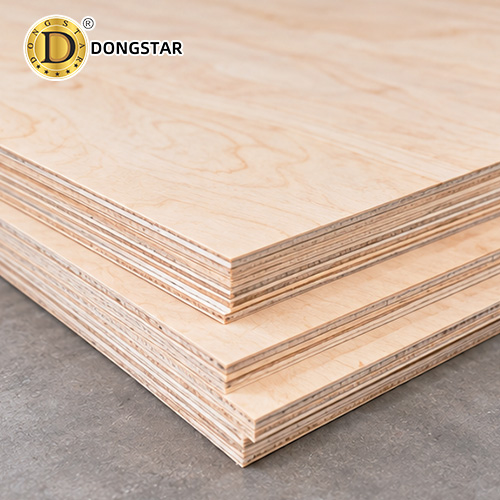
For B2B buyers, the edge of a plywood sample is useful here.
A clean, consistent edge can provide a quick visual indication of the internal layer construction. For larger orders, however, visual inspection should be supported by agreed specifications and quality testing.
Step 5: How Is Glue Applied to Plywood Veneers?
Adhesive is applied between the veneer layers before pressing.
The glue system is one of the most important specifications in plywood manufacturing because it affects the bonding performance and moisture resistance of the finished panel.
Common plywood adhesive systems include:
MR Glue
MR, or Moisture Resistant glue, is commonly used for interior applications where the plywood is exposed to normal humidity but does not require continuous severe water resistance.
Melamine Glue
Melamine-based adhesive systems can provide improved moisture resistance and bonding performance for applications requiring more than basic interior bonding.
WBP Glue
WBP means Water Boil Proof.
WBP bonding systems are commonly specified where the plywood needs stronger resistance to moisture and water exposure, subject to the applicable product standard and testing requirements.
Phenolic Glue
Phenolic resin is widely used for demanding plywood applications and is particularly common in many film faced plywood products used for concrete formwork.
The correct adhesive should be selected according to the application rather than simply choosing the most expensive option.
For an international RFQ, buyers should clearly state the required glue system and applicable standard.
Step 6: How Is Plywood Hot Pressed?
Hot pressing is one of the key stages in plywood production.
After the veneers are assembled and glued, the stack is placed into a press.
Controlled heat and pressure help the adhesive cure and bond the veneer layers into a solid panel.
The pressing process needs to be controlled carefully because factors such as:
- Temperature
- Pressure
- Pressing time
- Panel thickness
- Glue system
- Veneer moisture
can influence the final result.
Insufficient or uneven pressing can contribute to weak bonding or delamination.
Excessive or poorly controlled pressing can also affect veneer quality, thickness and panel stability.
This is why production experience matters.
A professional plywood factory should have established production parameters for different plywood specifications rather than using the same pressing conditions for every product.
Step 7: How Is Plywood Trimmed and Sanded?
After pressing, the plywood panel is processed to achieve the required finished dimensions and surface condition.
Trimming
The edges are cut to the specified length and width.
For export plywood, dimensional consistency is particularly important because buyers may use the panels in CNC cutting, furniture production, construction systems or other standardized processes.
Sanding
Depending on the product, plywood may be sanded on one or both sides.
Sanding can improve:
- Surface smoothness
- Thickness consistency
- Painting performance
- Lamination performance
- Furniture finishing
Some plywood products may receive additional surface treatment.
Film faced plywood, for example, uses a surface film rather than being treated in the same way as ordinary sanded commercial plywood.
The final surface specification should therefore be confirmed before purchasing.
Step 8: How Is Plywood Quality Checked?
Quality control should take place throughout production rather than only after the plywood is finished.
A professional plywood quality-control process may check:
Appearance
Inspect the face and back for:
- Open defects
- Surface damage
- Repairs
- Color variation
- Sanding quality
Dimensions
Check:
- Length
- Width
- Thickness
- Thickness tolerance
- Squareness
- Flatness
Internal Construction
The panel edge can be inspected for:
- Core gaps
- Veneer overlap
- Uneven layers
- Poor joints
- Internal defects
Bonding
Bonding performance is particularly important for plywood used in humid, structural or demanding applications.
Depending on the product, manufacturers may conduct appropriate bonding or water-resistance tests according to the agreed standard.
Moisture
Moisture content should be controlled according to the plywood specification and destination requirements.
Packaging
The final step is not simply putting plywood on a pallet.
For export orders, packaging should protect the panels during:
- Factory handling
- Truck transportation
- Port handling
- Container loading
- Sea transportation
- Final unloading
Good production quality can still be compromised by poor export packaging.
How Does the Manufacturing Process Affect Plywood Quality?
The easiest way to understand plywood manufacturing is to look at the relationship between each production stage and the final product.
| Production Stage | What It Can Affect |
|---|---|
| Log selection | Veneer quality, density and yield |
| Veneer production | Veneer thickness and appearance |
| Drying | Moisture and bonding consistency |
| Grading | Face quality and internal consistency |
| Lay-up | Panel balance and strength |
| Glue application | Bonding performance |
| Hot pressing | Adhesion, thickness and stability |
| Trimming | Sheet dimensions and squareness |
| Sanding | Surface quality and thickness |
| Inspection | Product consistency |
| Packaging | Protection during export |
This is why two factories can quote different prices for what appears to be the same plywood specification.
A lower price may come from differences in:
- Wood species
- Core construction
- Veneer grade
- Glue system
- Production control
- Sanding requirements
- Quality inspection
- Packaging
For bulk buyers, the goal should not be to find the lowest factory price in isolation.
The goal is to compare equivalent plywood specifications.
How Should Buyers Choose a Plywood Manufacturer?
Understanding how plywood is manufactured gives buyers a better way to evaluate factories.
Before placing a large order, ask the supplier to provide clear information about the production specification.
1. Ask About the Wood Species
Confirm both face/back species and core species.
Do not accept a general description such as “hardwood core” if the exact core construction matters to your application.
2. Ask About the Glue System
Specify whether you need MR, melamine, WBP, phenolic or another adhesive system.
If your market has specific emission or product requirements, include them in the RFQ.
3. Ask About Production Capability
A supplier should be able to explain whether the factory can consistently produce your required:
- Size
- Thickness
- Core
- Face grade
- Glue
- Surface treatment
- Quantity
4. Request Samples
A sample cannot replace factory inspection, but it can help you compare:
- Face quality
- Edge construction
- Thickness
- Flatness
- Sanding
- Bonding
- Overall workmanship
For a large project, approve the sample specification before mass production.
5. Check Quality Control
Ask how the factory controls veneer moisture, bonding, thickness and final dimensions.
A reliable manufacturer should have a repeatable process rather than depending entirely on individual workers.
6. Confirm Export Packaging
For international orders, packaging should be part of the product specification.
Ask how the plywood is:
- Stacked
- Protected
- Bundled
- Palletized
- Loaded into containers
7. Compare the Complete Quotation
A meaningful plywood price comparison should include the same:
size + thickness + face/back grade + core + glue + surface + certification + packaging + quantity.
Only then can different suppliers be compared fairly.
Plywood Manufacturing FAQs
How is plywood made?
Plywood is made by producing thin wood veneers, drying and grading them, arranging the layers with alternating grain directions, applying adhesive, hot pressing the assembly, then trimming, sanding and inspecting the finished panel.
What is the first step in plywood manufacturing?
The process normally starts with selecting suitable logs according to the required wood species, veneer quality and final plywood specification.
How are plywood veneers made?
Veneers can be produced by processing logs with rotary cutting or other veneer production methods. The resulting thin wood sheets are then dried and graded before plywood assembly.
Why are plywood veneers placed in different directions?
Cross-laminating adjacent veneer layers helps improve dimensional stability and creates a more balanced engineered wood panel.
What glue is used in plywood manufacturing?
Common systems include MR, melamine, WBP and phenolic adhesives. The appropriate system depends on the intended application and required bonding performance.
What is hot pressing in plywood manufacturing?
Hot pressing uses controlled heat and pressure to cure the adhesive and bond the veneer layers into a solid plywood panel.
How do manufacturers check plywood quality?
Quality control can include inspection of face and back appearance, dimensions, thickness, flatness, edge construction, bonding, moisture and other product-specific requirements.
How can I tell if a plywood factory is reliable?
Ask for detailed product specifications, samples, production information, quality-control procedures, certifications where applicable, export experience and clear packaging and loading information. For large orders, factory verification or third-party inspection can provide additional confidence.
Does the manufacturing process affect plywood price?
Yes. Wood species, veneer grade, core construction, glue system, production controls, surface treatment, quality requirements and packaging can all affect the final plywood cost.
Final Takeaway
Plywood manufacturing is a controlled sequence rather than a single production step.
From log selection and veneer production to drying, grading, lay-up, gluing, hot pressing, sanding and inspection, every stage can influence the final panel.
For global B2B buyers, this matters because a plywood quotation is only meaningful when the underlying product specification is clear.
Before comparing plywood manufacturers, define:
- Plywood type
- Face and back veneer
- Core material
- Glue system
- Sheet size
- Thickness
- Surface requirement
- Applicable standards
- Certification
- Packaging
- Quantity
Then compare suppliers using the same specification.
That approach gives importers, wholesalers, furniture manufacturers and project buyers a much clearer picture of both plywood quality and plywood price.
For large-volume purchasing, the right question is not simply:
“How much does plywood cost?”
It is:
“How consistently can this manufacturer produce the plywood specification my market requires?”
That is where manufacturing capability becomes a purchasing advantage.
Recommended Reading from Dongstar Blog
- What Is Plywood? Types, Uses & Buying Guide | Dongstar
- Can You Order Custom Plywood Sizes and Thicknesses? A B2B Manufacturer Guide
- What Is Plywood Made Of? Plywood Layers, Veneers & Core Explained
- Plywood Sheets Wholesale Sizes: Standard & Custom Guide
- How Thick Is 3/4 Inch Plywood in mm? 1/2″ & 5/8″ Guide
- 1220×2440mm vs 1250×2500mm Plywood: Size Guide for Buyers
- 12mm vs 18mm Plywood: Which Thickness Should You Choose?
Post time: Oct-08-2026