
Plywood may look like a simple wood panel, but a plywood sheet is actually a carefully engineered combination of wood veneers, core layers and adhesive.
For B2B buyers, understanding what plywood is made of is important because two sheets with the same size and thickness can have very different performance, appearance, weight and price.
The difference may come from the veneer species, core construction, glue system, face grade or manufacturing process.
This guide explains the main components of plywood, how the layers are assembled, and what global project buyers, furniture manufacturers, wholesalers and importers should check before placing a bulk order.
What Is Plywood Made Of?
Plywood is mainly made from thin layers of natural wood veneer bonded together with adhesive.
A typical plywood sheet contains four basic elements:
- Face veneer
- Core veneers
- Back veneer
- Adhesive
The veneers are normally arranged so that the grain direction of adjacent layers crosses. This cross-laminated construction helps improve dimensional stability and reduces the tendency of the panel to split or deform in the same way as a single piece of wood.
The exact plywood construction depends on the product.
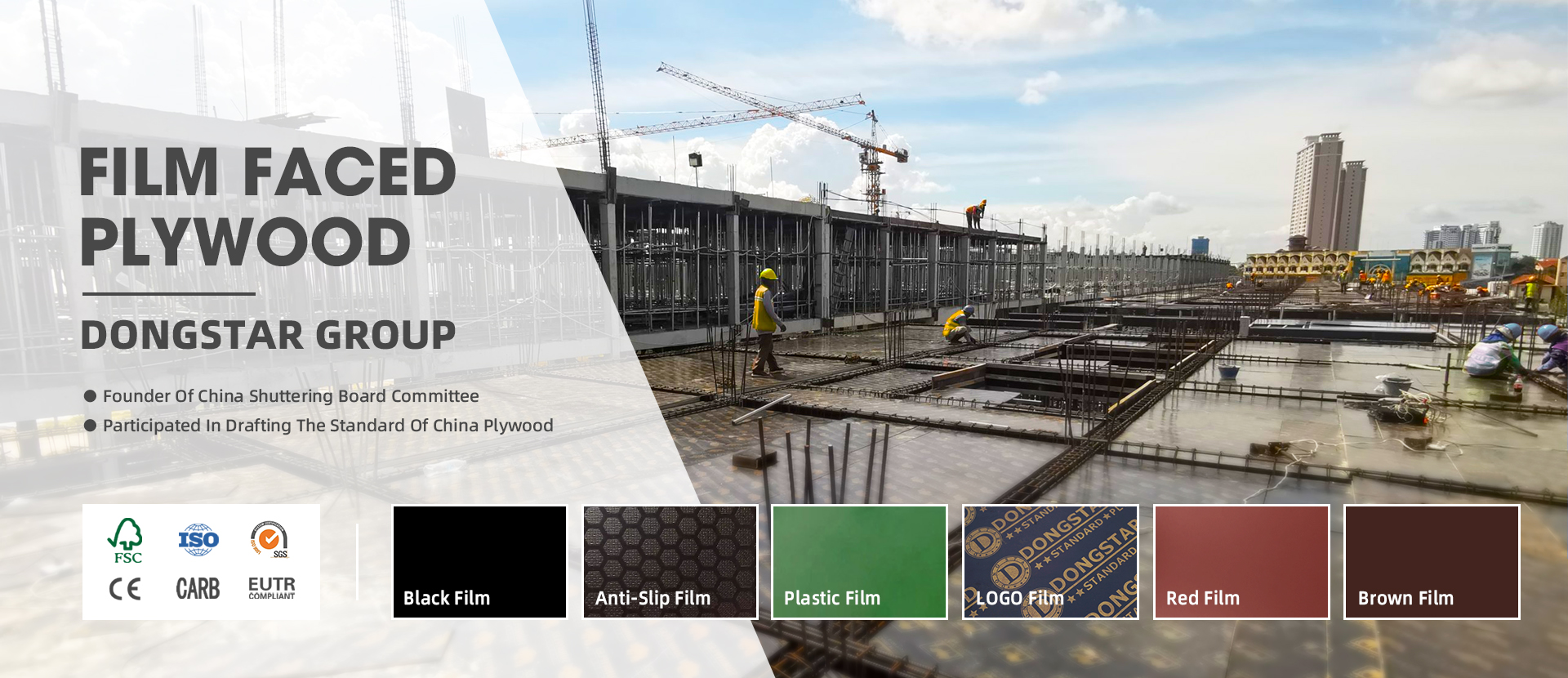
For example, furniture plywood may prioritize surface appearance and machining performance, while construction plywood may require a different core and bonding system. Film faced plywood uses a surface film for concrete formwork applications.
This is why professional buyers should not evaluate plywood only by its thickness or appearance.
A more complete specification includes:
wood species + veneer grade + core + glue + thickness + size + surface treatment + applicable standard.
What Are the Different Layers of Plywood?
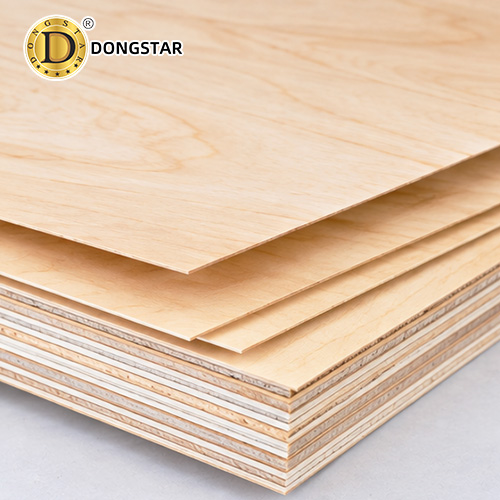
Plywood is built from multiple veneer layers. The number of layers varies according to the required thickness and construction.
Face Veneer
The face is the visible surface of the plywood sheet.
For furniture and decorative applications, face veneer quality is particularly important because it affects:
- Appearance
- Smoothness
- Painting performance
- Lamination performance
- Surface defects
- Final product quality
Common face veneer species include birch, pine, okoume, bintangor, sapele and other hardwood or softwood species.
Core Veneers
The core makes up most of the internal structure of the plywood.
Core construction affects:
- Strength
- Weight
- Stability
- Screw-holding performance
- Machining behavior
- Price
A high-quality plywood core should be properly dried, accurately assembled and consistently bonded.
For B2B buyers, core quality can be more important than the surface appearance because defects inside the panel may not be visible until the plywood is cut or machined.
Back Veneer
The back veneer forms the opposite surface of the panel.
Its grade does not always need to match the face grade. For example, furniture plywood may have a higher-grade face with a more economical back, depending on the final application.
The required face/back combination should therefore be specified clearly in the purchase order.
Adhesive Layers
Adhesive is applied between the veneer layers to create a bonded panel.
The glue system affects the plywood’s resistance to moisture, bonding strength, emissions and suitability for different applications.
This is one of the most important specifications to confirm when comparing plywood suppliers.
What Is Plywood Veneer?
Plywood veneer is a thin layer of natural wood used to manufacture plywood.
The veneer production method and wood species influence the appearance and properties of the finished panel.
Rotary-Cut Veneer
Rotary-cut veneer is produced by rotating a log against a cutting blade.
It can produce wide veneer sheets efficiently and is commonly used in commercial plywood production.
Sliced Veneer
Sliced veneer is cut from a prepared section of wood rather than continuously peeling the entire log.
It is often selected when a more specific grain appearance is required for furniture or decorative applications.
Face Veneer vs Core Veneer
Not every veneer in a plywood sheet has the same quality requirement.
The face veneer is normally selected for appearance and surface performance, while core veneers are selected more heavily for structural consistency, stability and production efficiency.
This difference explains why a plywood sheet can have a premium-looking face while using a different species or grade inside.
For bulk purchasing, buyers should specify both face material and core material instead of simply asking for “hardwood plywood.”
What Is Plywood Core Made Of?
Plywood core can be made from different wood species or combinations of species.
Common plywood core materials include:
| Core Material | Typical Characteristics | Common B2B Applications |
|---|---|---|
| Birch | Dense, uniform and stable | Furniture, cabinets, CNC components |
| Eucalyptus | Good strength-to-cost balance | Furniture, construction, general plywood |
| Poplar | Lightweight and economical | Furniture, packaging, interior applications |
| Pine | Lightweight with good machinability | Construction, furniture, structural uses |
| Hardwood | Higher density and strength potential | Furniture, construction, industrial applications |
| Combi Core | Combination of different wood species | Commercial plywood, furniture, general applications |
There is no universal “best” plywood core.
A furniture manufacturer may prefer a stable and uniform core for CNC machining. A wholesaler may need a balance between price, weight and performance. A construction buyer may prioritize strength and bonding performance.
The correct core should therefore be selected according to the final application.
Why Does Core Quality Matter?
Poor internal construction can lead to problems such as:
- Core gaps
- Overlapping veneers
- Uneven thickness
- Weak bonding
- Delamination
- Poor edge machining
- Reduced screw-holding performance
For this reason, experienced buyers often inspect the edge of a plywood sample before approving a large order.
The edge can reveal much more about the internal construction than the face alone.
What Glue Is Used to Make Plywood?
Plywood adhesive bonds the individual veneer layers into one panel.
Different glue systems are used for different applications.
MR Glue
MR generally means Moisture Resistant.
It is commonly used for interior applications where the plywood may experience normal humidity but is not intended for continuous severe moisture exposure.
Melamine Glue
Melamine-based adhesive systems can provide improved moisture resistance compared with basic interior bonding systems.
They are commonly used for plywood products where a stronger bonding performance is required.
WBP Glue
WBP means Water Boil Proof.
WBP plywood is designed for applications where stronger resistance to moisture and water exposure is required, subject to the specific test standard and product specification.
Phenolic Glue
Phenolic resin is widely used in demanding plywood applications, including many film faced plywood products for concrete formwork.
It can provide strong bonding and moisture resistance when properly manufactured.
Emission Requirements
For furniture and interior applications, buyers may also specify formaldehyde emission requirements such as E0, E1 or E2, depending on the destination market and applicable regulations.
These classifications should not be treated as interchangeable with waterproof performance.
A plywood specification should separately define:
bonding performance + emission requirement + applicable standard.
How Is Plywood Made?
Understanding the manufacturing process helps buyers understand why production quality matters.
1. Log Selection
Logs are selected according to the required wood species, veneer quality and plywood specification.
2. Veneer Production
The logs are processed into thin veneer sheets.
The thickness and quality of the veneer depend on the product construction.
3. Veneer Drying
Fresh veneer contains significant moisture.
Controlled drying helps bring the veneer to a suitable moisture level for bonding and further processing.
4. Veneer Grading
Veneers are sorted according to appearance, defects and quality.
Higher-grade veneer is normally used where surface appearance is important.
5. Lay-Up
The veneers are arranged into the required sequence.
Adjacent layers are generally oriented in different grain directions to create the cross-laminated plywood structure.
6. Glue Application
Adhesive is applied between the veneer layers according to the selected glue system.
7. Hot Pressing
The assembled veneers are pressed under controlled temperature and pressure.
This process creates the bonded plywood panel.
8. Trimming and Sanding
The panel is trimmed to the required dimensions and may be sanded to achieve the specified surface quality and thickness.
9. Quality Inspection
A professional plywood production process should include inspection of dimensions, thickness, surface condition, bonding and other agreed specifications.
For export orders, packaging and loading are also important because damage can occur after the plywood leaves the production line.
How Do Veneer, Core and Glue Affect Plywood Performance?
The performance of plywood is not determined by one material alone.
Consider a simple example.
Two panels may both be:
1220 × 2440 × 18 mm plywood.
However, one may use a lightweight poplar core and interior glue, while another uses a hardwood or birch-based core with a stronger bonding system.
They may have the same dimensions but different:
- Density
- Strength
- Moisture resistance
- Screw-holding performance
- Surface quality
- Weight
- Price
- Suitable applications
This is why B2B buyers should compare the complete plywood construction, not just the headline product name.
A useful procurement comparison looks like this:
| Specification | What to Confirm |
|---|---|
| Face | Species and grade |
| Back | Species and grade |
| Core | Species and construction |
| Glue | MR, melamine, WBP, phenolic or required system |
| Thickness | Nominal thickness and tolerance |
| Size | Finished length and width |
| Density | Required range |
| Moisture | Required range |
| Surface | Sanded, unsanded, film faced or decorative |
| Certification | Destination-market requirements |
| Packaging | Export packing and loading method |
How Should B2B Buyers Choose Plywood Materials?
Start with the application instead of starting with the lowest price.
For Furniture Manufacturing
Prioritize:
- Face appearance
- Core uniformity
- Thickness tolerance
- Machining performance
- Screw holding
- Surface finishing
- Formaldehyde emission requirements
For Construction
Focus more heavily on:
- Structural requirements
- Core strength
- Bonding performance
- Moisture resistance
- Thickness consistency
- Applicable standards
For Concrete Formwork
Film faced plywood is normally considered rather than ordinary untreated plywood.
Buyers should evaluate:
- Panel thickness
- Core construction
- Film type
- Glue system
- Edge sealing
- Expected reuse
- Concrete finish requirements
For Packaging
Important factors include:
- Weight
- Strength
- Cost
- Nail and screw holding
- Cutting efficiency
- Required dimensions
For importers and wholesalers, the supplier’s ability to reproduce the same specification from order to order is also important.
A low-cost sample is not enough if the factory cannot maintain the same core, veneer quality and glue system during mass production.
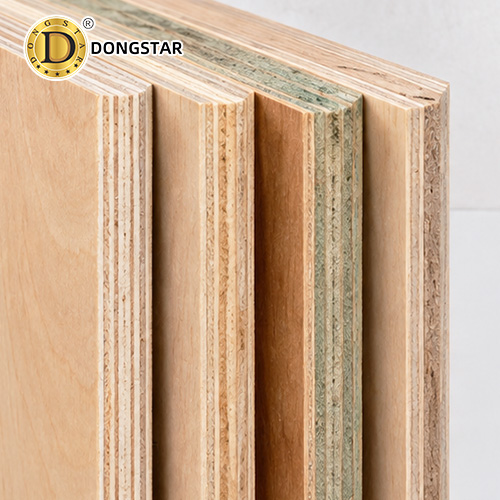
What Plywood Materials Does Dongstar Supply?
Dongstar’s current plywood range includes commercial, furniture, hardwood, construction and waterproof plywood, with different face/back veneer species, core materials, grades and glue systems available according to product specifications.
The current product information lists common sheet sizes including 1220 × 2440 mm, 1250 × 2500 mm and 1250 × 3000 mm, with thickness options of approximately 2.7–40 mm, depending on the plywood configuration. Core options include birch, eucalyptus, poplar, pine, combi and mixed hardwood, while listed glue options include MR, melamine, WBP and phenolic systems.
For international buyers, this configuration-based approach is useful because plywood can be specified around the actual project rather than treated as one standardized product.
When requesting a quotation, provide:
- Plywood type
- Sheet size
- Thickness
- Face and back veneer
- Face/back grade
- Core material
- Glue system
- Moisture requirement
- Certification requirements
- Quantity and destination
A complete RFQ gives the manufacturer enough information to quote comparable products and reduces misunderstandings between buyer and supplier.
Plywood Materials FAQs
What is plywood made of?
Plywood is made mainly from thin wood veneers bonded together with adhesive. The panel normally contains face veneer, core veneers and a back veneer.
What is the core of plywood?
The plywood core is the internal veneer structure between the face and back. Common core materials include birch, eucalyptus, poplar, pine, hardwood and combi constructions.
Which wood is commonly used to make plywood?
Many wood species can be used, including birch, eucalyptus, poplar, pine, okoume, bintangor and other hardwoods and softwoods. The choice depends on the required appearance, strength, weight, application and cost.
What is the difference between plywood veneer and plywood core?
The veneer is the individual thin wood layer used to build the panel. The core refers to the internal layers of the plywood, while the face and back are the outer layers.
What glue is used in plywood?
Common plywood adhesives include MR, melamine, WBP and phenolic systems. The correct glue depends on the application’s moisture exposure, bonding requirements and applicable standards.
Does plywood have different numbers of layers?
Yes. Plywood can contain different numbers of veneer layers depending on the required thickness and construction. The number and arrangement of layers are determined by the manufacturer’s production specification.
How can I check plywood quality before a bulk order?
Request a representative sample and check the face, back, edge construction, thickness, flatness and bonding. For a professional purchase, also confirm the core, glue, moisture, tolerance, certification and production specification before mass production.
Final Takeaway
Plywood is an engineered wood panel, but it is not a single standardized material.
Its final performance comes from the combination of veneer, core, glue, grade, thickness, surface treatment and manufacturing quality.
For global B2B buyers, understanding these components makes it easier to compare plywood suppliers, evaluate quotations and select the right product for furniture, construction, packaging or industrial applications.
When requesting a bulk plywood quotation, do not simply ask for a price per sheet.
Specify the complete construction.
The more precise the specification, the easier it is for a professional plywood manufacturer to provide a consistent product and a meaningful quotation.
Recommended Reading from Dongstar Blog
- What Is Plywood? Types, Uses & Buying Guide | Dongstar
- Can You Order Custom Plywood Sizes and Thicknesses? A B2B Manufacturer Guide
- Plywood Sheets Wholesale Sizes: Standard & Custom Guide
- How Thick Is 3/4 Inch Plywood in mm? 1/2″ & 5/8″ Guide
- 1220×2440mm vs 1250×2500mm Plywood: Size Guide for Buyers
- 12mm vs 18mm Plywood: Which Thickness Should You Choose?
Post time: Sep-28-2026