


1220×2440 Plywood: Complete Specifications & Buying Guide for Bulk Buyers
1220×2440 plywood is one of the most widely used sheet formats in international plywood trading. Often referred to as 4×8 plywood, this dimension is commonly specified for furniture manufacturing, construction, interior panels and general woodworking.
For importers, wholesalers and project buyers, however, sheet dimensions are only the starting point. Thickness, face veneer, core construction, glue type and manufacturing tolerance all influence the final product.
This guide explains what to check when sourcing 1220×2440 plywood, how to select the right specification, and what information to provide when requesting a factory quotation.
Table of Contents
- What Is 1220×2440 Plywood?
- 1220×2440 Plywood Dimensions and Specifications
- Common Plywood Thicknesses and Their Uses
- Face Veneer, Core and Glue Options
- Main Applications of 1220×2440 Plywood
- How to Check Plywood Quality Before Ordering
- How to Calculate Material Requirements and Shipping
- How to Choose a 1220×2440 Plywood Manufacturer
- 1220×2440 Plywood FAQs
What Is 1220×2440 Plywood?
1220×2440 plywood is a wood-based engineered panel measuring approximately 1,220 mm wide and 2,440 mm long. It is commonly associated with the nominal 4×8 ft plywood format.
The panel is manufactured by bonding multiple thin wood veneers together, usually with adjacent veneer grain directions arranged at right angles. This layered construction helps improve dimensional stability and provides a versatile material for different manufacturing and construction requirements.
For B2B buyers, 1220×2440 plywood is a practical format because it is familiar to many furniture factories, distributors and construction material suppliers. It can also be specified with different thicknesses, veneer species, grades, core materials and adhesive systems.
The important point is that the same sheet size does not mean the same plywood quality. Buyers should evaluate the complete product specification rather than purchasing by dimensions alone.
1220×2440 Plywood Dimensions and Specifications
The nominal dimensions of this plywood format are:
| Specification | Typical Details |
|---|---|
| Sheet width | 1220 mm |
| Sheet length | 2440 mm |
| Imperial reference | Approximately 4×8 ft |
| Common thickness range | Depends on product construction |
| Face and back | Birch, Pine, Okoume, Bintangor, Poplar and others |
| Core options | Birch, Eucalyptus, Poplar, Pine, Combi and MLH |
| Glue options | MR, Melamine, WBP and Phenolic |
| Surface | Sanded or unsanded, depending on product |
| Grades | A/C, BB/BB, BB/CC, C/D and other agreed grades |
The nominal sheet area is approximately 2.98 m².
For international orders, buyers should confirm the actual finished dimensions and acceptable manufacturing tolerances with the supplier. The nominal 4×8 designation should not replace a written millimeter specification.
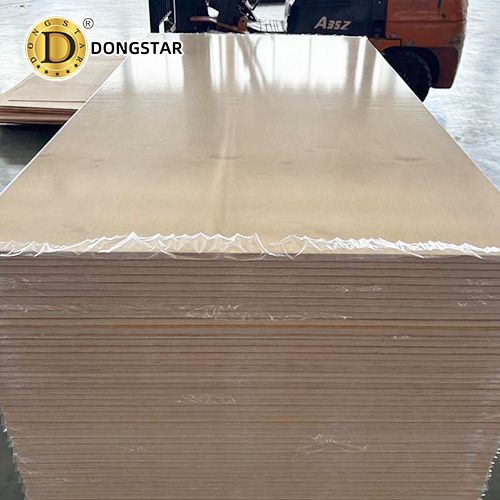
Dongstar lists 1220×2440 mm among its plywood formats, alongside 1250×2500 mm, 1250×3000 mm and customized dimensions. Available combinations depend on the product type and order requirements.
Common Plywood Thicknesses and Their Uses
Choosing the correct thickness is essential for material performance, machining and cost control.
The following table provides a practical reference for common plywood thicknesses:
| Thickness | Typical Applications |
|---|---|
| 3–6 mm | Drawer bottoms, backing panels and lightweight components |
| 9 mm | Furniture components, interior panels and packaging |
| 12 mm | Cabinet components, shelving and general interior use |
| 15 mm | Furniture structures and partition components |
| 18 mm | Cabinets, furniture panels, shelving and general construction |
| 21 mm | Heavy-duty furniture components and selected construction uses |
| 25 mm and above | Specialized structural, industrial or heavy-duty applications |
These are indicative applications, not universal engineering recommendations. The appropriate thickness depends on the panel construction, support spacing, load, installation method and relevant project standards.
For example, 18 mm plywood is frequently specified for furniture and cabinet production, while thinner panels may be more suitable for backing and lightweight components.
For bulk orders, always specify the nominal thickness and acceptable thickness tolerance. If the panels will be used in CNC machining or automated production, consistent thickness can be particularly important.
Face Veneer, Core and Glue Options
The face veneer, core and adhesive system determine much of a plywood panel’s appearance and performance.
1. Face and Back Veneer
Common veneer options include:
- Birch: A relatively uniform appearance, often selected for furniture and interior applications.
- Pine: A natural wood appearance for construction, furniture and general-purpose panels.
- Okoume: A lightweight face veneer used in furniture and decorative applications.
- Bintangor: Commonly used for commercial plywood and general interior applications.
- Poplar: An economical option for selected commercial and furniture products.
The required face and back grades should be clearly defined. Terms such as BB/BB, BB/CC and A/C should be confirmed against the supplier’s grading criteria and approved sample.
2. Core Construction
Common plywood core materials include Birch, Eucalyptus, Poplar, Pine, Combi and mixed hardwood (MLH).
Birch core is often selected when a dense, relatively uniform multi-layer construction is required. Poplar and mixed-core options may be considered where weight and cost are important. Eucalyptus and other hardwood cores are used for different strength and performance requirements.
There is no single best core for every application. Buyers should compare the actual construction, density, bonding and performance requirements.
3. Glue Type
Common adhesive options include:
- MR glue: For moisture-resistant interior applications.
- Melamine glue: For improved moisture resistance in suitable applications.
- WBP glue: Used where water-boil-proof bonding performance is required under specified test conditions.
- Phenolic glue: Commonly specified for demanding construction and formwork applications.
Do not rely only on descriptions such as “waterproof plywood.” Ask for the actual adhesive specification and relevant test documentation.
Main Applications of 1220×2440 Plywood
The 4×8 sheet format is suitable for a wide range of commercial and industrial applications.
Furniture Manufacturing
Used for cabinets, wardrobes, shelves, tables, furniture components and built-in storage. Buyers should focus on face quality, core construction, thickness consistency and machining performance.
Construction and Building Materials
Depending on the product grade and technical specification, plywood can be used for wall panels, flooring components, roofing applications and general building work. Structural uses must meet the relevant project requirements.
Interior Decoration
Plywood is used for wall cladding, ceiling components, decorative panels and interior fixtures. Face veneer selection is particularly important when the finished surface remains visible.
Packaging and Industrial Use
Plywood sheets can be processed into industrial crates, transport packaging, machinery boxes and protective panels. Thickness and strength should match the weight and handling conditions of the packaged goods.
For concrete formwork, buyers should specify film faced plywood rather than assuming that ordinary commercial plywood is suitable.
How to Check Plywood Quality Before Ordering
A competitive quotation is not enough to confirm product quality. For wholesale and project orders, buyers should establish inspection requirements before production.
Important checks include:
- Dimensions: Measure sheet length, width and thickness against the agreed specification.
- Flatness: Check whether the panels show unacceptable bending or warping.
- Surface quality: Inspect veneer appearance, open defects, patches, sanding and surface consistency.
- Core construction: Check for unacceptable gaps, overlaps or other visible core defects at the panel edges or approved samples.
- Bonding: Confirm that the glue system and bonding performance meet the agreed requirements.
- Moisture content: Check whether the moisture level meets the product specification.
- Packaging: Confirm edge protection, pallet condition, labeling and export packaging.
For large orders, buyers should approve a sample and agree on inspection methods, tolerances and acceptance criteria before mass production.
Where certificates or compliance documents are required, verify that they apply to the specific product, factory and destination market.
How to Calculate Material Requirements and Shipping
A 1220×2440 mm plywood sheet has a nominal area of approximately 2.98 m².
To estimate the total panel area:
Total area = Number of sheets × 2.9768 m²
For example, 1,000 sheets provide approximately 2,976.8 m² of nominal panel area.
For procurement planning, buyers should also consider:
- Cutting layouts and expected material waste.
- Panel thickness and total shipment volume.
- Pallet dimensions and stacking height.
- Container payload and loading arrangement.
- Packaging materials and destination handling requirements.
Do not estimate container quantity from sheet area alone. Actual loading capacity depends on plywood thickness, density, packaging, pallet configuration, container type and weight restrictions.
Ask the manufacturer for a loading plan based on the exact product specification and destination.
How to Choose a 1220×2440 Plywood Manufacturer
When comparing a 1220×2440 plywood supplier, buyers should look beyond the price per sheet.
A reliable manufacturer should be able to explain its production capability, available veneer and core options, glue systems, quality control procedures and export packaging.
Before placing a bulk order, request:
- A complete product specification sheet.
- Factory or production information.
- Samples for evaluation.
- Details of thickness and dimensional tolerances.
- Relevant test reports and certification documents.
- MOQ, production lead time and payment terms.
- Packaging details and estimated container loading quantity.
For a fair comparison, send the same specification to every supplier. A quotation for 18 mm poplar-core MR plywood should not be compared directly with one for 18 mm hardwood-core WBP plywood.
Dongstar supplies different plywood types for international B2B customers, with 1220×2440 mm available as one of its listed sheet formats. Buyers can discuss face veneer, core, glue, grade, thickness and packaging requirements according to their projects.
Visit the Dongstar Plywood product page to review the available product range.
1220×2440 Plywood FAQs
Is 1220×2440 mm the same as 4×8 plywood?
It is the commonly used metric equivalent of nominal 4×8 ft plywood. Buyers should still confirm the actual finished dimensions and tolerance with the manufacturer.
How many square meters are in one 1220×2440 plywood sheet?
One sheet covers approximately 2.9768 m² based on its nominal dimensions.
What is the most popular thickness for 1220×2440 plywood?
18 mm is a commonly specified thickness for furniture and cabinet production. However, the best thickness depends on the intended application and engineering requirements.
Can I order 1220×2440 plywood with different core materials?
Yes. Depending on the manufacturer and product type, options may include Birch, Eucalyptus, Poplar, Pine, Combi and mixed hardwood cores. Confirm availability for the required thickness and grade.
Is 1220×2440 plywood suitable for construction?
It can be used in various construction applications when the plywood type, grade, bonding system and technical performance meet the project requirements. Structural applications should follow the relevant specifications and standards.
Can a plywood factory supply 1220×2440 mm in custom thicknesses?
Many manufacturers offer multiple thickness options, subject to production capability and order quantity. Buyers should confirm the available thickness, tolerance and MOQ before ordering.
What information should I include in a plywood quotation request?
Provide the product type, 1220×2440 mm sheet size, thickness, face and back grade, core material, glue type, quantity, destination market, packaging and any certification requirements.
Final Thoughts
1220×2440 plywood remains a practical sheet format for international furniture, construction, interior and industrial supply chains. But the right purchasing decision depends on more than the 4×8 dimensions.
For bulk buyers, a clearly defined specification, consistent quality inspection and a capable manufacturing partner are essential to controlling material costs and avoiding problems after delivery.
If you are sourcing 1220×2440 plywood for wholesale distribution or a project, contact Dongstar with your required thickness, face grade, core, glue type and quantity to discuss suitable product options.
| Recommended Blog | URL |
|---|---|
| What Is Plywood? Types, Uses & Buying Guide | Read Article |
| What Is Plywood Made Of? Plywood Layers, Veneers & Core Explained | Read Article |
| Standard Plywood Sheet Sizes: 4×8, 1220×2440mm & More | Read Article |
| Plywood Sizes & Thickness: Standard Sheet Dimensions Guide 2026 | Read Article |
| 1220×2440mm vs 1250×2500mm Plywood: Size Guide for Buyers | Read Article |
| Can You Order Custom Plywood Sizes and Thicknesses? | Read Article |
| Plywood Sheets Wholesale Sizes: Standard & Custom Guide | Read Article |
Post time: Nov-05-2026