
Table of Contents
- What is Medium Density Fibreboard MDF?
- Why MDF is Popular for Cabinets
- Types of MDF Board for Cabinet Manufacturing
- How to Choose the Right MDF Board
- Popular Surface Finishes for MDF Cabinets
- Common MDF Thickness for Cabinets
- How to Choose an MDF Board Supplier
- Why Importers Source MDF from China
- 2026 MDF Board Pricing Trends
- FAQs
Cabinet manufacturers and furniture importers are paying closer attention to material selection than ever before. Rising customer expectations, increasing competition, and changing interior design trends are pushing buyers to find cabinet materials that balance quality, appearance, and cost.
That’s exactly why demand for Medium Density Fibreboard MDF continues growing across global furniture and interior markets.
For wholesalers, contractors, and project buyers, selecting the right MDF board is not simply about choosing the cheapest option. The wrong board can lead to swelling, surface defects, poor machining performance, and expensive customer complaints.
In this guide, we’ll explain how to choose the best MDF board for cabinet production, what specifications matter most, and how to work with a reliable MDF Board Supplier in 2026.
What is Medium Density Fibreboard MDF?
Medium Density Fibreboard MDF is an engineered wood panel made from wood fibers, wax, and resin compressed under high temperature and pressure.
Unlike natural wood, MDF has:
- A smooth and uniform surface
- Consistent density
- Excellent machining performance
- Easy finishing capability
Because MDF contains no visible grain patterns or knots, it has become one of the most widely used materials for cabinet manufacturing.
Why MDF is So Popular in Furniture Production
Modern furniture factories prefer MDF because it:
- Cuts cleanly
- Supports precision CNC machining
- Works well with laminates and melamine
- Creates smooth painted finishes
- Reduces material waste
For cabinet doors and decorative furniture, MDF often provides a more refined appearance than solid wood or lower-grade plywood.
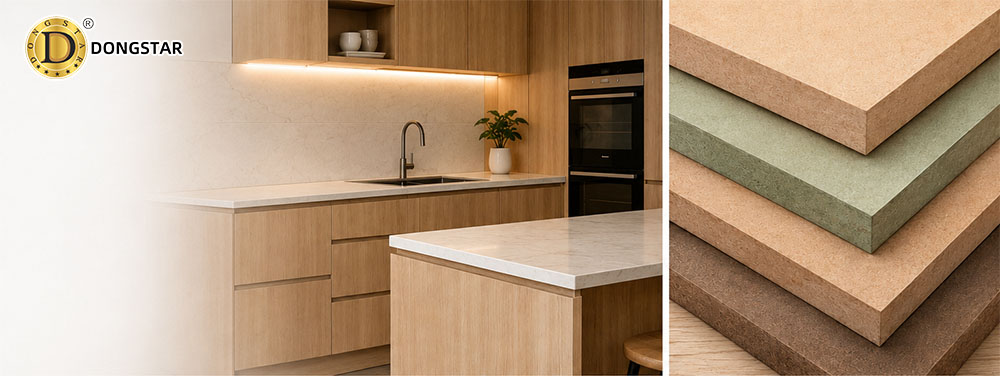
Why MDF is Popular for Cabinets
Cabinet manufacturing requires materials that are stable, affordable, and visually consistent.
1. Smooth Surface Finish
MDF is ideal for:
- Painted cabinet doors
- PVC laminates
- Melamine finishes
- Decorative coatings
The smooth surface allows manufacturers to achieve premium visual results with less finishing work.
2. Excellent Machining Performance
Compared with natural wood, MDF produces cleaner edges and smoother routed designs.
This is especially important for:
- CNC cutting
- Decorative edge profiling
- Custom cabinet production
3. Cost Efficiency
For large-scale furniture projects, MDF offers a strong balance between performance and affordability.
That’s why many global furniture exporters continue using MDF for:
- Kitchen cabinets
- Wardrobes
- Office furniture
- Bathroom vanities
4. Stable Structure
Unlike solid wood, MDF is less likely to warp or crack under normal indoor conditions.
Types of MDF Board for Cabinet Manufacturing
Not all MDF boards are the same.
Understanding different MDF categories helps buyers choose the correct product for each project.
Standard MDF
Standard MDF is suitable for:
- Dry indoor applications
- Bedroom furniture
- Shelving systems
- Decorative panels
Moisture Resistant MDF
Moisture resistant MDF is designed for humid environments such as:
- Kitchens
- Bathrooms
- Laundry areas
It typically contains special additives that improve resistance to swelling.
Fire Resistant MDF
This type is commonly used in:
- Commercial projects
- Public buildings
- Office interiors
Melamine MDF
Melamine MDF combines decorative melamine paper with MDF core material.
Advantages include:
- Scratch resistance
- Faster production
- Modern appearance
- Lower finishing cost
Melamine MDF remains one of the fastest-growing cabinet materials globally.
How to Choose the Right MDF Board
Choosing the right MDF board requires more than comparing prices.
1. Density
Higher density MDF usually provides:
- Better screw holding
- Improved durability
- Cleaner machining
For cabinets, medium to high-density MDF is generally preferred.
2. Moisture Resistance
For kitchen or bathroom cabinets, moisture-resistant MDF is highly recommended.
Always ask suppliers for:
- Water absorption test reports
- Swelling data
- Technical specifications
3. Formaldehyde Emission Standards
Many international markets now require:
- E0
- E1
- CARB P2 certification
Low-emission MDF is becoming a key selling point for importers.
4. Surface Quality
Check for:
- Smoothness
- Flatness
- Sanding consistency
- Edge density
Poor surface quality can increase painting and lamination costs later.
5. Thickness Tolerance
Inconsistent thickness causes major problems during cabinet assembly.
Reliable manufacturers maintain tight thickness control during production.
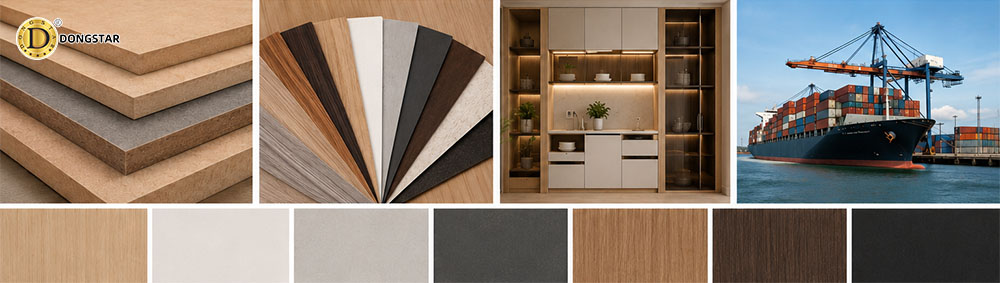
Popular Surface Finishes for MDF Cabinets
Modern cabinet buyers expect more stylish surface options than ever before.
Popular MDF Surface Treatments
Melamine Finish
Affordable and durable for mass-market furniture.
PVC Lamination
Provides decorative textures and moisture protection.
High Gloss UV Coating
Popular for modern kitchen cabinets.
Wood Veneer
Creates a natural wood appearance with premium visual appeal.
Trending Colors in 2026
Current global furniture trends include:
- Matte white
- Warm oak
- Walnut textures
- Dark gray
- Super matte black
These finishes are especially popular in European and Middle Eastern markets.
Common MDF Thickness for Cabinets
Different cabinet applications require different board thicknesses.
| Thickness | Typical Application |
|---|---|
| 3mm | Back panels |
| 6mm | Drawer bottoms |
| 9mm | Decorative panels |
| 12mm | Cabinet doors |
| 15mm | Furniture components |
| 18mm | Cabinet carcasses |
| 25mm | Countertops & premium furniture |
Among all options, 18mm MDF remains the global standard for cabinet manufacturing.
How to Choose an MDF Board Supplier
Finding the right supplier is one of the most important decisions for importers.
What Reliable Suppliers Should Offer
- Stable quality control
- Large-scale production capacity
- Export experience
- OEM customization
- Technical documentation
- Consistent board density
Questions Buyers Should Ask
What raw materials are used?
Fiber quality affects board performance significantly.
What certifications are available?
Look for:
- FSC
- CARB
- CE
- ISO certifications
How is moisture controlled?
Poor moisture control can cause warping during shipping.
Red Flags to Avoid
- Extremely low pricing
- Inconsistent board color
- Weak packaging
- Unclear technical specifications
A professional MDF Board Supplier should provide transparent communication and stable long-term supply capability.
Why Importers Source MDF from China
China continues to dominate global MDF exports because of:
- Competitive manufacturing costs
- Advanced production lines
- Large export capacity
- Product customization flexibility
Advantages of Chinese MDF Manufacturers
Product Variety
Chinese factories can produce:
- Raw MDF
- Melamine MDF
- Moisture resistant MDF
- Fire resistant MDF
- Laminated MDF boards
OEM Support
Many importers work directly with factories to customize:
- Thickness
- Surface finish
- Density
- Packaging
Growing Demand for MDF Cabinets Manufacturer Partnerships
Many furniture brands now cooperate directly with Chinese factories for:
- OEM cabinet production
- Ready-to-assemble furniture
- Large-scale commercial projects
2026 MDF Board Pricing Trends
MDF pricing in 2026 is affected by:
- Wood fiber supply
- Resin costs
- Energy prices
- Shipping rates
- Environmental regulations
Current Market Trends
Global demand is increasing for:
- Low-emission MDF
- Moisture resistant MDF
- Decorative MDF panels
- Customized melamine finishes
Importers are also prioritizing stable supply chains over ultra-low pricing.
FAQs
Is MDF good for kitchen cabinets?
Yes. Moisture resistant MDF is widely used for kitchen cabinets because of its smooth finish and stable structure.
What thickness is best for cabinets?
18mm MDF is commonly used for cabinet carcasses and furniture structures.
Is MDF better than plywood for cabinets?
MDF provides a smoother surface for painting and decorative finishes, while plywood offers better moisture resistance and screw holding.
What is the difference between standard MDF and moisture resistant MDF?
Moisture resistant MDF contains additives that reduce swelling in humid environments.
Can MDF be laminated?
Yes. MDF works very well with melamine, PVC, veneer, and high gloss laminates.
How do I choose a reliable MDF Board Supplier?
Choose suppliers with export experience, certifications, stable quality control, and strong production capacity.
Conclusion
Choosing the right Medium Density Fibreboard MDF for cabinet production can directly affect furniture quality, customer satisfaction, and long-term profitability.
For importers, wholesalers, and project contractors, understanding density, moisture resistance, surface quality, and supplier reliability is essential before placing large-volume orders.
Working with a professional MDF Board Supplier and experienced MDF Cabinets Manufacturer helps ensure consistent product quality and smoother project execution in 2026 and beyond.
Recommended Reading from Dongstar Blog
- What is Plywood? Complete Guide for Importers in 2026
- Marine Plywood vs Commercial Plywood: 2026 Buyer Comparison Guide from a Trusted China
- What is Melamine Board? 2026 Buyer’s Guide to Melamine Plywood & Melamine MDF
- How much does a 4×8 sheet of 3/4 plywood weigh? Cost Guide 2026
- How Much is a Sheet of Plywood? 2026 Price Guide + 6 Cost-Saving Tips
- Plywood Shelving Ideas: Simple & Stylish Storage Solutions
- Plywood vs. MDF vs. Particle Board: Which is Best for Your Project?
- A Successful Conclusion | The 139th Canton Fair Concludes Successfully – Dongstar Group Moves Forward with Honors, Opening a New Chapter in Global Cooperation
Post time: May-11-2026